塽
Character Story & Explanation
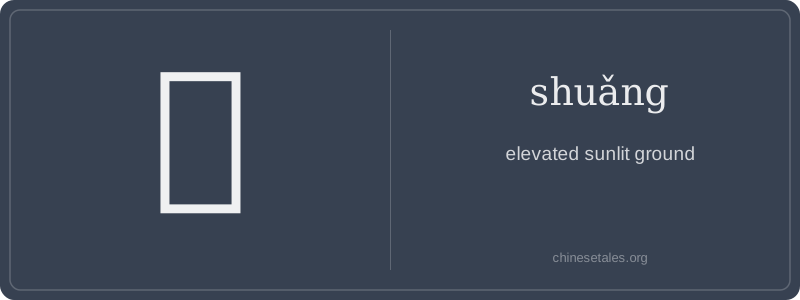
The earliest form of 塽 appears in Han dynasty seal script as a compound of 土 (earth/ground) on the left and 爽 (originally depicting four windows in a roof, symbolizing openness and light) on the right. Over time, the four 'windows' in 爽 simplified into two ×-like shapes above two 'hands' (), while the 土 radical stabilized at the left. Crucially, the original oracle bone idea wasn’t about sunlight *per se*, but about *unobstructed vertical space*: a raised mound where wind and light move freely — hence the emphasis on elevation + exposure, not mere brightness.
This meaning crystallized in texts like the Classic of Mountains and Seas (Shānhǎi Jīng), where 塽 describes auspicious highlands favored for settlement — places free from damp fog and stagnant air. By the Tang dynasty, poets used 塽 to evoke serene, healthful vistas: Du Fu once praised a scholar’s retreat as '地势塽垲,竹木清疏' ('the land elevated and sunlit, bamboo and trees gracefully sparse'). Visually, the character still whispers its origin: 土 anchors it to earth, while the elegant symmetry of 爽 above signals airy openness — a hilltop where you can finally see *and breathe*.
At first glance, 塽 (shuǎng) feels like a breath of fresh air — literally. Its core meaning is 'elevated sunlit ground': think of a high, open terrace bathed in clear morning light, unobstructed by trees or buildings. It’s not just 'bright' or 'open'; it’s the *spatial quality* of being both raised and sun-drenched, evoking clarity, ventilation, and psychological uplift. This isn’t a daily-use word — you won’t hear it in street conversations — but it lives vividly in classical poetry, place names (like 塽子沟), and literary descriptions of landscape.
Grammatically, 塽 functions almost exclusively as an adjective, often in fixed compounds or poetic apposition (e.g., 塽垲形容地势高而干燥). It rarely stands alone; instead, it pairs with characters like 垲 (kǎi, 'dry, elevated land') to form 塽垲 — a classical binome meaning 'high, dry, sun-exposed terrain'. Learners sometimes misread it as a synonym for 爽 (shuǎng, 'refreshing,爽快'), but that’s a dangerous mix-up: 爽 carries emotional or sensory immediacy ('refreshing breeze', 'feeling great'), while 塽 is strictly topographic and visual — no emotion, no subjectivity, just geography lit by the sun.
Culturally, 塽 embodies the Chinese literati’s deep attention to micro-geography: how elevation, exposure, and light interact to shape habitability and aesthetic resonance. Mistaking it for 爽 also risks sounding archaic or unintentionally poetic — imagine saying 'this coffee shop is 塽' instead of 爽 — it would confuse native speakers, who’d wonder if you’re describing its rooftop terrace, not its vibe. Also note: its radical is 土 (earth), not 日 (sun) — a subtle reminder that its brightness comes from *position*, not illumination itself.