堑
Character Story & Explanation
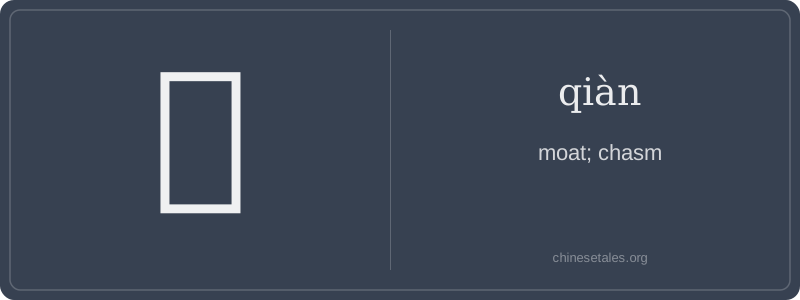
The earliest form of 堑 appears in Warring States bamboo slips — not oracle bones, but still ancient — as a compound pictograph: 土 (tǔ, 'earth') on the left, and 口 (kǒu, 'mouth') + 彐 (jì, a variant of 彐, later evolving into the top part of 斩) on the right. That right side wasn’t 'mouth' literally — it was a stylized depiction of a *blade cutting downward into soil*, with the horizontal stroke representing the surface level. Over centuries, the blade morphed into the radical 斤 (jīn, 'axe'), and the whole right side condensed into 斩 (zhǎn, 'to chop'), giving us today’s structure: 土 + 斩 = earth chopped deeply — i.e., a moat.
This visual logic held firm across dynasties. In the Records of the Grand Historian, Sima Qian describes generals digging 堑 to halt cavalry charges — not just digging, but *cutting* the land like a weapon. By Tang poetry, 堑 had acquired metaphorical depth: Du Fu wrote of ‘heavenly chasms’ (天堑 tiān qiàn), referring to the Yangtze River as a natural defensive barrier — transforming geography into destiny. The character’s shape remains a silent testament: every stroke tells of earth violently, deliberately severed.
At its heart, 堑 (qiàn) evokes a deep, deliberate cut into the earth — not just any ditch, but one with strategic weight: a moat guarding a fortress or a chasm symbolizing an unbridgeable divide. In Chinese, it’s never casual; it carries gravity, even danger. You won’t hear it in daily chatter like 'I dug a hole' — that’s 挖坑 (wā kēng). 堑 appears in historical narratives, military texts, or poetic metaphors where separation is structural, consequential, and often man-made.
Grammatically, 堑 functions almost exclusively as a noun, rarely as a verb. It pairs tightly with words like 护 (hù, 'to protect') or 天 (tiān, 'heavenly'), forming compounds like 护城堑 (hù chéng qiàn, 'city-moat'). Unlike English 'moat', which can be whimsical (think castle toys), 堑 resists lightness — you’d never say 'a cute little 堑'. Learners sometimes mistakenly use it for natural ravines (better: 峡谷 xiá gǔ), but 堑 implies human intention: defense, exclusion, or boundary-making.
Culturally, 堑 reflects China’s long-standing relationship with terrain as strategy — walls, rivers, and ditches weren’t just geography, they were policy. A common error? Confusing it with 坑 (kēng, 'pit') — but while 坑 can be accidental or even metaphorical ('falling into a scam pit'), 堑 is always purposeful, wide, and formidable. Its rarity in modern speech makes it feel archaic and resonant — like hearing a drumbeat from a Ming dynasty garrison.