塬
Character Story & Explanation
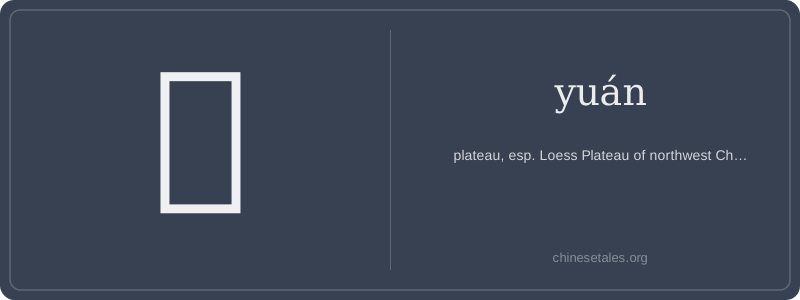
The earliest form of 塬 appears not in oracle bones—but in late bronze inscriptions and early seal script, where it was written as 圜 (yuán, 'circle, round') with 土 added below as a semantic clarifier. The original 圜 depicted a circular enclosure—think of a walled settlement atop flat ground—and the addition of 土 (earth/soil) emphasized its physical, earthen nature. Over time, 圜 simplified: the outer frame became the modern 元 (yuán, 'first, origin'), retaining the two horizontal strokes and the 'lid' shape at the top, while 土 remained firmly anchored at the bottom—13 strokes total, each one grounding the meaning in earth and elevation.
This evolution reflects how meaning crystallized around landscape specificity: by the Han dynasty, 塬 referred explicitly to elevated, flat-topped landforms formed by loess accumulation—distinct from mountains (山), hills (丘), or plains (原). Though 原 itself means 'plain' or 'original', the addition of 土 transformed it into a technical geomorphological term. Classical texts like the Shuǐ Jīng Zhù (Commentary on the Water Classic) describe river systems cutting through ‘yuán’ terrain—showing how early cartographers recognized these plateaus as defining features of the northwest’s hydrology and settlement patterns.
Imagine standing on the edge of a vast, wind-scoured expanse in Shaanxi—golden loess stretching to the horizon, silent except for the low hum of distant sheep bells. That flat-topped, steep-sided landform beneath your boots? That’s a yuán. Not just any ‘plateau’—this word carries the gritty weight of the Loess Plateau (Huángtǔ Gāoyuán), where centuries of dust deposition created terrains so distinctive they earned their own character. In Chinese, 塬 isn’t used abstractly or metaphorically: it’s geographically precise, almost geological. You’ll almost never say ‘a 塬’ alone—it appears in proper nouns (like Guānzhōng Píngyuán) or compound terms like 黄土塬.
Grammatically, 塬 is a noun-only, countable landform term—never a verb, never an adjective. Learners sometimes mistakenly treat it like 平原 (píngyuán, 'plain') and drop it into generic descriptions ('big plateau'), but native speakers reserve it for the specific loess-capped tablelands of northwestern China. It rarely appears without modifiers: 黄土塬, 黄土高原上的塬, or paired with directional terms like 北塬 (běi yuán, 'northern plateau'). You won’t find it in weather reports or casual travel blogs—it lives in geography textbooks, archaeological papers, and local place names.
Culturally, 塬 is quietly iconic: it’s where ancient Zhou and Qin civilizations took root, where cave dwellings (yáodòng) are carved into its soft cliffs, and where soil erosion studies begin. Mistaking it for 平原 or 高原 is common—but that’s not just linguistic sloppiness; it erases the unique geomorphology and cultural memory embedded in this single, unassuming character.