塥
Character Story & Explanation
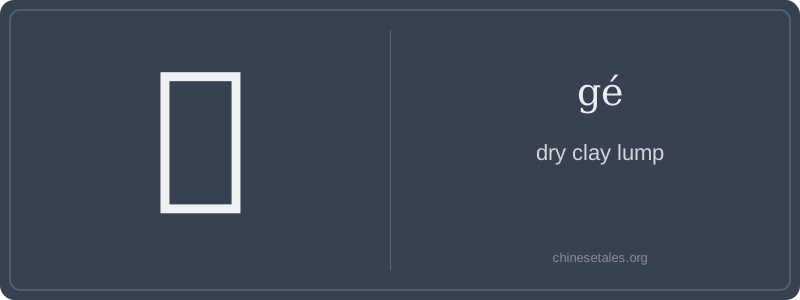
The earliest form of 塥 appears in Han dynasty clerical script (lìshū), not oracle bones — it’s a relatively late creation. Its left side is the radical 土 (tǔ, ‘earth’), anchoring it firmly in the domain of soil and land. The right side, originally written as 各 (gè), was a phonetic component meaning ‘each’ or ‘individually’, but here it served only to signal pronunciation. Over time, 各 simplified visually: the top ‘夂’ (zhǐ, ‘to go’) stroke softened into a dot-and-hook, while the lower ‘口’ (kǒu, ‘mouth’) became compressed and angular — resulting in today’s compact, slightly jagged right-hand component. Thirteen strokes total: seven for 土 (including the horizontal stroke extending rightward), six for the evolved 各.
This character emerged precisely because ancient Chinese agrarian society needed fine-grained vocabulary for soil states. In the Shuōwén Jiězì (121 CE), Xu Shen defines it tersely as ‘堅土也’ (jiān tǔ yě) — ‘hard, dry earth’. It wasn’t about beauty or metaphor; it was about diagnosing field conditions. The visual pairing of 土 + 各 subtly reinforces the idea of ‘earth in discrete, individual units’ — each 塥 is a self-contained lump, distinct from surrounding soil. This pragmatic precision echoes across centuries: modern soil scientists in Shaanxi still use 塥 in technical reports to denote unconsolidated, non-cohesive clay aggregates formed during drought cycles.
Think of 塥 (gé) as the Chinese equivalent of a 'clay brick that forgot it was supposed to be fired' — a dry, crumbly lump of earth that’s neither fully soil nor proper pottery. It’s not poetic or abstract like many classical characters; it’s tactile, gritty, and hyper-specific: a noun for one very particular stage in earthen material transformation. You won’t find it in daily conversation — it’s a field-term, used by potters, archaeologists, or farmers describing uncultivated, hardened patches in loam-rich soil.
Grammatically, 塥 is strictly a standalone noun — no verb forms, no adjectival usage, no common reduplications. It rarely appears without modifiers: ‘干塥’ (gān gé, ‘dry clay lump’) or ‘硬塥’ (yìng gé, ‘hard clay lump’) are far more frequent than bare 塥. Learners sometimes mistakenly treat it like 块 (kuài, ‘piece’) and try to use it with measure words — but 塥 itself *is* the unit: you say ‘一塥土’ (yī gé tǔ), not ‘一塊塥’. That’s because 塥 already implies a discrete, naturally formed mass — like saying ‘a clod’ in English, where ‘clod’ contains its own countability.
Culturally, 塥 carries quiet agricultural gravity: it’s the stubborn remnant of soil that resists cultivation — a tiny obstacle in the plow’s path, a sign of poor drainage or compaction. Classical texts rarely mention it (it’s too mundane for poetry), but local gazetteers from the Loess Plateau region use it precisely when documenting land fertility. A common mistake? Confusing it with 隔 (gé, ‘to separate’) — same sound, totally different world: one is about earth under your fingernails, the other about walls between people.