埙
Character Story & Explanation
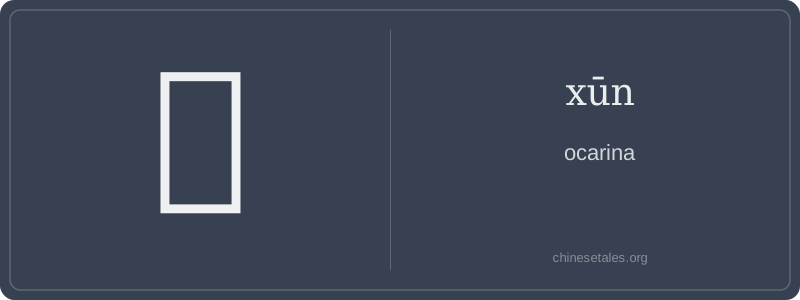
The earliest form of 埙 appears on Shang dynasty oracle bones as a simple, rounded pictograph — a lopsided oval with three small dots inside, representing finger holes and the hollow chamber. By the Zhou bronze inscriptions, it evolved into a more structured shape: a rounded top (the blowing end) and a wider base, with strokes suggesting both the clay body and perforations. The modern character preserves that essence: the left-side 土 (earth/clay) radical anchors its material origin, while the right side 元 (yuán) — originally depicting a person’s head — was phonetically borrowed for its sound and later stylized into the current 亘-like form. Crucially, the 10 strokes map neatly: 土 (3) + 元 (4) + two extra horizontal strokes (3) = 10, mirroring the typical number of holes on a mature Han-dynasty xūn.
This character didn’t just name an instrument — it encoded philosophy. In the Rites of Zhou, the xūn is classified among the ‘eight sounds’ (八音) under ‘earth’ (土音), because it’s made of clay and produces a grounded, resonant timbre symbolizing stability and sincerity. Classical poets like Bai Juyi used 埙 to evoke melancholy authenticity — contrasting it with the bright, artificial tones of metal bells. Even today, conservators restoring Ming tombs report finding intact 埙 buried beside scholars’ remains, their silent presence speaking louder than any epitaph: this wasn’t music — it was breath given form by earth.
Imagine you’re wandering through a quiet courtyard in Xi’an at dusk, and from behind an ancient clay wall drifts a haunting, earthy melody — low, breathy, and strangely ancient. That sound? It’s coming from a xūn: a globular, egg-shaped ocarina made of baked clay, with five to ten finger holes and no mouthpiece — you blow across its notch like a bottle. In Chinese, 埙 isn’t just ‘a flute’ or ‘an instrument’; it’s the *only* word for this specific prehistoric wind instrument, deeply tied to ritual, mourning, and scholarly refinement. You’ll never hear 埙 used as a verb — it’s strictly a noun, always countable (e.g., 一只埙), and almost never pluralized without a classifier.
Grammatically, it behaves like other cultural artifact nouns: it appears after measure words (一隻埙, 一支埙), often modified by material (陶埙 ‘clay xūn’) or era (汉代埙 ‘Han-dynasty xūn’). Learners sometimes misread it as xūn (like 熏) or confuse it with 薰 (also xūn, but meaning ‘aromatic herb’), leading to comical mistranslations like ‘I burned incense with my ocarina’. Also, don’t try to use it metaphorically — unlike 笛 (flute) or 箫 (end-blown flute), 埙 carries zero colloquial or slang usage. It’s sacred, specific, and stubbornly literal.
Culturally, the xūn is one of China’s oldest surviving musical instruments — archaeologists have unearthed Neolithic versions over 7,000 years old. Its tone is deliberately muted and introspective, associated with yin energy, funerals, and Confucian rites — not celebration. That’s why you’ll find it in classical poetry describing solitude (e.g., ‘埙声幽咽’, ‘the xūn’s voice wails softly’) but never in pop lyrics. If you say 埙 in conversation, listeners will assume you’re either a musician, an archaeologist, or someone quoting the Classic of Rites.