坞
Character Story & Explanation
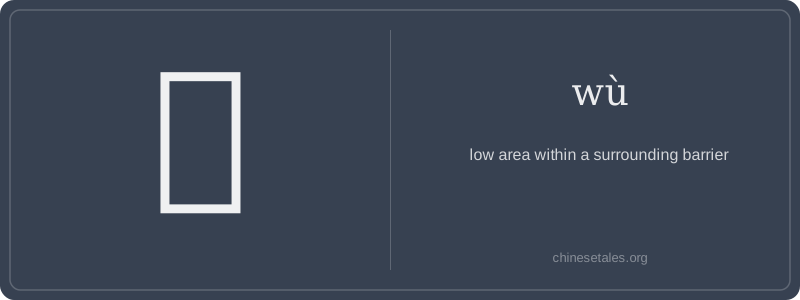
The earliest form of 坞 appears in seal script as a combination of 土 (tǔ, earth/soil) on the left and 乌 (wū, crow) on the right—but crucially, the 'crow' part wasn’t chosen for its meaning. It was a *phonetic loan*: in Old Chinese, 乌 sounded close enough to *wù* to serve as a sound hint. Visually, imagine 土 anchoring the character at the base—ground, foundation—and the upper-right component evolving from a stylized crow (with beak and wings) into today’s simplified 乌-like shape. Over centuries, the crow’s legs and feathers smoothed into the clean strokes we see: the dot, horizontal, and hook-then-vertical.
This phonetic pairing is classic Chinese character logic: borrow a familiar sound, then ground it with meaning. The 'earth' radical tells us this is fundamentally about landform—not birds! By the Han dynasty, 坞 had crystallized its core sense: a protected enclosure, especially one built into terrain. Cao Cao’s strategist Xun Yu wrote of ‘mountain wùs’ as strategic reserves; later, Tang poets used it to evoke secluded retreats—‘a lone pavilion nestled in a misty wù.’ Even now, the visual echo of ‘earth + crow’ whispers: *this is where the land folds inward to shelter life.*
At its heart, 坞 (wù) evokes a very Chinese kind of spatial intelligence: not just 'a low place,' but specifically a *sheltered* low place—like a natural bowl ringed by hills, or a fortified courtyard tucked into a valley. It’s not about emptiness or depression; it’s about containment, protection, and quiet resilience. You’ll rarely hear it in daily speech—it’s literary, poetic, and geographically precise. Think of it as the opposite of an open plain: this is where you’d build a mountain hermitage, hide a rebel camp, or store grain safely away from wind and raiders.
Grammatically, 坞 functions almost exclusively as a noun, often in compound words (like 山坞 or 船坞), and almost never alone. Learners sometimes try to use it like a generic 'valley' (谷 gǔ) or 'bay' (湾 wān), but that’s off-key—wù implies human intention or natural fortification, not just topography. You wouldn’t say 'I hiked into a wù'; you’d say 'the ancient village clings to the mouth of a mountain wù.' It’s a word that assumes context: history, terrain, and purpose are baked into its usage.
Culturally, 坞 reveals how deeply Chinese thought links landform and safety. In dynastic times, 'wù' often meant a fortified hamlet—think of the Warring States period, when clans built earthen-walled enclaves in defensible hollows. Today, it survives most vividly in naval contexts (船坞 chuánwù = dry dock), where the 'barrier' becomes steel walls holding back the sea. A common mistake? Pronouncing it like 'wū' (as in 乌) — but the fourth tone is firm and decisive, like the thud of a gate closing.