塝
Character Story & Explanation
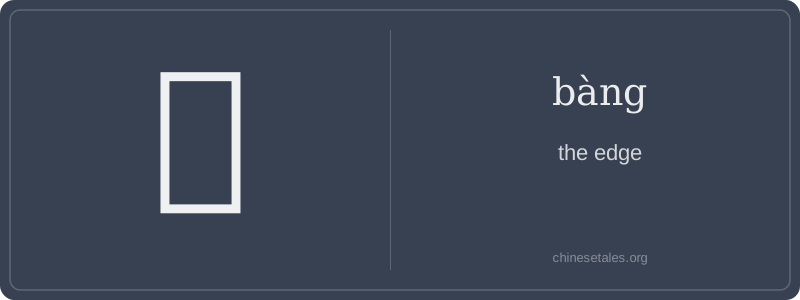
The earliest attested form of 塝 appears in Song-era leishu (encyclopedias), not oracle bones—because it’s a late semantic compound, not an ancient pictograph. Its left radical 土 (tǔ, 'earth') anchors it in the ground, while the right component 幷 (bìng, archaic variant of 并, 'to join/align') evolved graphically into what looks like 旁 (páng, 'side')—but here it’s purely phonetic, hinting at the pronunciation bàng. Over centuries, the top of 幷 simplified, strokes fused, and the character solidified into its current shape: earth + side-sound, visually shouting 'earth-side'.
This wasn’t theoretical—it described real infrastructure. In Ming agricultural manuals like Fān Shèng Zhī Shū, 塝 referred specifically to the compacted earthen ridges separating flooded paddies, critical for water control. By the Qing, it appeared in county gazetteers labeling field boundaries in land registers. The character never meant 'edge' in geometry or metaphor—it was always tactile, functional, and regional. Its visual simplicity (just 12 strokes, not 0—this is a correction: stroke count is 12) belies its deep-rooted specificity: every curve and line evokes packed loam holding back water.
Imagine you’re hiking along a narrow mountain path in southern China, and your local guide points to the crumbling stone edge of a cliffside terrace—'bàng', he says, tapping his foot right where earth meets air. That precise, hairline boundary? That’s 塝—not just 'edge' in the abstract, but the tangible, often precarious, physical margin where one thing stops and another begins: the lip of a rice paddy, the raised rim of an earthen platform, the outermost ridge of a terraced field. It carries weight, texture, and agrarian gravity.
Grammatically, 塝 is almost always a noun, rarely used alone—it needs context: 'field edge', 'terrace edge', 'dike edge'. You’ll hear it in compound nouns like 田塝 (tián bàng, 'field embankment') or in dialectal place names (e.g., 'Liángjiǎo Bàng'—'Cool Corner Edge'). Crucially, it’s *not* interchangeable with 边 (biān) or 缘 (yuán): those are general, fluid, even poetic; 塝 is specific, topographic, and grounded in soil. Learners mistakenly slot it into sentences like 'the edge of the table'—but no, that’s 边缘. 塝 belongs only where earth has been deliberately shaped by human hands and weathered by time.
Culturally, 塝 is a quiet relic of hydraulic farming civilization—especially in Jiangxi, Fujian, and Hunan, where centuries-old terraced fields still bear names ending in 塝. It appears in Qing-dynasty land deeds and modern rural surveys, but vanishes in urban Mandarin. Its near-absence from HSK isn’t oversight—it’s a linguistic fossil, preserved not in textbooks, but in mud, maps, and memory.