塙
Character Story & Explanation
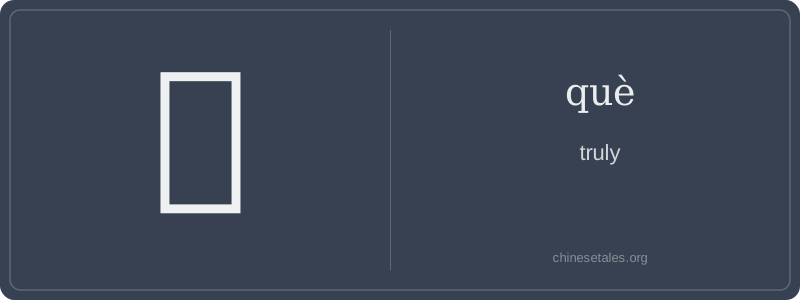
The earliest form of 塙 appears in seal script (around 3rd century BCE), not oracle bones — it’s relatively late-born. Its structure is transparent: left side 土 (tǔ, 'earth', 'soil'), right side 勺 (sháo, 'ladle', but here acting phonetically for què). Wait — ladle? Yes! In ancient times, 勺 was used as a phonetic component for sounds like què (via Old Chinese *kʰʷak), much like how 'light' and 'night' share spelling but diverged in sound. The character wasn’t pictographic per se, but ideophonetic: earth + sound clue. Over time, the right side evolved from 勺 to a stylized form resembling 卻 (què, 'to reject'), though they’re unrelated — a classic case of visual drift.
This character first surfaces seriously in Eastern Han commentaries and Tang dynasty poetry, always reinforcing factual or moral certainty: 'This matter is as solid as bedrock — no argument.' Its semantic power comes precisely from 土: truth isn’t abstract — it’s grounded, immovable, literally earthen. In the 12th-century *Shuowen Jiezi*, Xu Shen defines it as 'firm, real, without doubt' — linking physical stability to epistemic certainty. That earth-rooted authenticity remains its soul: when 塙 appears, the writer isn’t just stating something — they’re stamping it into the soil.
塙 (què) is a beautifully archaic character meaning 'truly', 'indeed', or 'certainly' — but don’t expect to see it on street signs or WeChat chats. It’s a literary fossil, preserved mostly in classical texts, formal essays, and poetic invocations of sincerity or irrefutable truth. Think of it as the Chinese equivalent of Shakespearean 'forsooth' — grammatically an adverb, but carrying weight like a solemn oath. It always modifies verbs or entire clauses, often appearing at the beginning or middle of a sentence for emphasis: 塙有其事 (què yǒu qí shì) — 'It is indeed the case.'
Grammatically, 塙 behaves like other classical adverbs of certainty (e.g., 诚 chéng, 实 shí), but with sharper, almost geological finality — fitting, given its radical. Unlike modern 真 (zhēn) or 确实 (quèshí), 塙 doesn’t combine freely in speech; you won’t hear it in conversation or news broadcasts. Learners sometimes mistakenly insert it into colloquial sentences expecting 'very' or 'really', but that’s like sprinkling truffle salt on instant noodles — technically edible, culturally jarring.
Culturally, 塙 evokes Confucian rhetorical precision: it appears in pre-Qin and Han texts where truth must be anchored in tangible reality — hence its earth radical (土). A common mistake is confusing it with 确 (què), which *does* mean 'certain' but is everyday, compound-friendly, and lacks 塙’s solemn, unyielding tone. Using 塙 instead of 确 in a business email would read like signing off with 'Verily, yours' — impressive, but slightly alarming.