塕
Character Story & Explanation
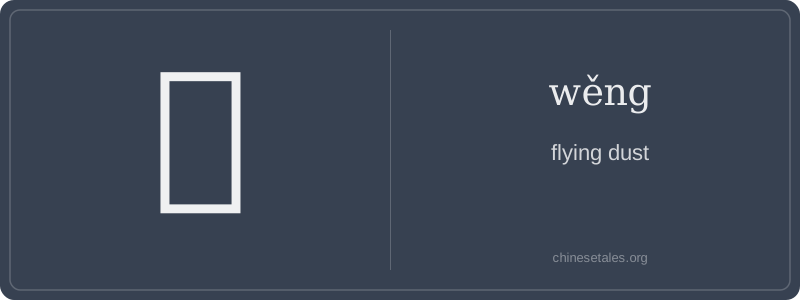
The earliest form of 塕 isn’t found in oracle bones — it’s a later creation, likely emerging in the Warring States or Han period as a phono-semantic compound. Visually, it’s built from 土 (tǔ, 'earth', the radical at left) and 甬 (yǒng, originally a pictograph of a bell-shaped vessel or passageway, here serving phonetically). But the genius lies in stroke order: the three horizontal lines above 甬 mimic swirling particles — not static dirt, but dust *in flight*. That top cluster (一 一 一) wasn’t added for decoration; it’s a deliberate visual onomatopoeia, echoing the chaotic lift of fine earth caught in wind currents.
Over centuries, 塕’s meaning stabilized around ‘flying dust’, distinct from broader terms like 塵 (chén, general dust) or 埃 (āi, microscopic dust). It appears in the Shuōwén Jiězì (c. 100 CE) as 'dust raised by wind' — and notably, the commentary emphasizes its *motion*, not its substance. This kinetic focus explains why classical poets used it only in dynamic scenes: galloping horses stirring 塕, autumn gales lifting 塕, or desert caravans vanishing into 塕. The character’s shape — earth literally launching upward — remains its semantic anchor across two millennia.
Imagine standing on a windswept northern plain as a dust devil swirls — not the gentle haze of 沙 (shā, sand), nor the choking smog of 霾 (mái), but something more sudden, airborne, and granular: that’s 塕 (wěng). Its core feeling is kinetic and transient — flying dust kicked up by wind, not settled soil or manufactured pollution. In classical usage, it often appears in poetic or descriptive contexts, evoking arid landscapes or chaotic motion; you’ll rarely hear it in casual speech today, and never in formal news or daily conversation — it’s a literary fossil with sharp sensory texture.
Grammatically, 塕 functions almost exclusively as a noun, usually modified by measure words like 一陣 (yī zhèn, 'a gust') or adjectives like 迷眼的 (mí yǎn de, 'eye-stinging'). It doesn’t verbify — you can’t ‘塕’ something — and it never stands alone as a subject without context: saying just '塕' sounds like muttering a weather phenomenon mid-sentence. Learners sometimes misread it as wēng (like 翁) due to the 甬 component, but the third tone is non-negotiable — mispronouncing it risks sounding like 'a fat old man' instead of 'a whirl of grit.'
Culturally, 塕 carries a subtle regional flavor: it appears most often in northern Chinese literature (e.g., Lu Xun’s early essays describing Shaoxing’s dusty roads — though he used it sparingly) and historical texts describing frontier conditions. Modern writers reach for it when they want linguistic austerity — a single character that conjures dryness, exposure, and impermanence. Its rarity makes it a quiet signature of stylistic intention: if a contemporary writer uses 塕, they’re not just describing dust — they’re summoning atmosphere.