塓
Character Story & Explanation
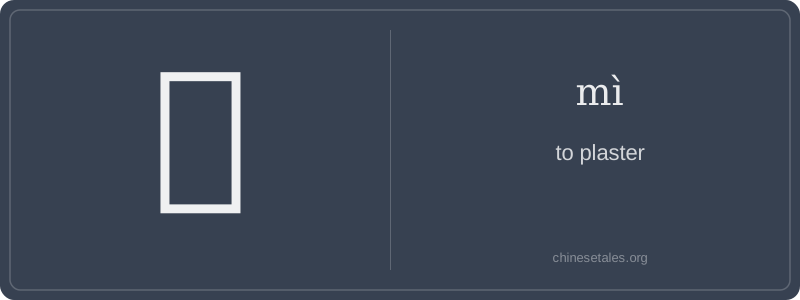
The earliest form of 塓 appears in Warring States bamboo slips (c. 475–221 BCE) as a compound pictograph: left side 尸 (shī, 'corpse' or 'person crouching') — not as death, but as a *kneeling artisan* — and right side 土 (tǔ, 'earth'), visually depicting someone pressing clay onto a surface with their hands and body weight. Over time, 尸 evolved into the radical ⺁ (a simplified 'roof' or 'cover' shape), while 土 remained unchanged — hence the modern structure: ⺁ + 土. No strokes were added or lost; instead, meaning intensified through semantic fusion — the roof-like top suggests *covering*, and earth confirms *material*.
By the Tang dynasty, 塓 had shifted from literal wall-plastering to include ceremonial uses: Confucian rites prescribed 塓棺 (mì guān, 'plastering the coffin') with fine clay to seal impurity, linking physical adhesion to moral containment. The Zhuangzi even uses 塓 metaphorically: 'His words 塓心而不漏' ('plastered the heart without leakage') — describing unshakeable inner composure. This semantic stretch shows how a craft-verb became a psychological image: just as clay seals cracks, wisdom seals distraction. Visually, the tight fit of ⺁ over 土 mirrors this idea — no gap, no leak, no ambiguity.
At first glance, 塓 (mì) feels like a quiet, dusty verb — 'to plaster' — but it’s actually a masterclass in Chinese material thinking: the character doesn’t just describe an action; it embodies the *intimacy between human hands and earth*. In classical usage, 塓 specifically meant applying wet clay or lime mortar to walls, beams, or even coffins — a ritual of sealing, protecting, and harmonizing structure with substance. Unlike generic verbs like 涂 (tú, 'to paint'), 塓 implies *adhesion*, *layering*, and *functional permanence*: you don’t 塓 a canvas — you 塓 a rammed-earth wall.
Grammatically, 塓 is almost always transitive and requires a tangible surface as its object — never abstract concepts. You’ll hear it in construction contexts (e.g., 塓墙), but rarely in daily speech today; modern Mandarin prefers 抹 (mǒ) or 粉刷 (fěnshuā). Learners often misplace tones (confusing mì with mǐ or mī) or wrongly treat it as intransitive ('the wall was plastered' → *incorrect* without explicit agent or passive marker like 被). Also, avoid using it for drywall joint compound — that’s still 腻子 (nìzi), not 塓.
Culturally, 塓 reveals how deeply Chinese craftsmanship valued *material fidelity*: plaster wasn’t decoration — it was breath control for buildings, moisture regulation for granaries, and spiritual sealing for tombs. In Han dynasty texts, 塓 appears alongside terms like 築 (zhù, 'to build') and 篱 (lí, 'bamboo fence'), forming a triad of boundary-making verbs. Mistake it for a synonym of 涂, and you erase centuries of embodied ecological knowledge — a subtle but profound linguistic loss.