埘
Character Story & Explanation
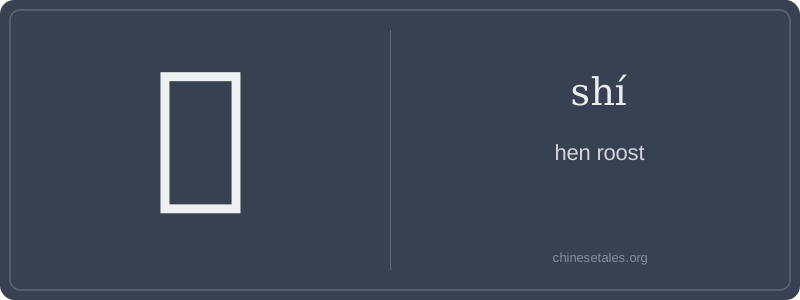
The earliest form of 埘 appears in bronze inscriptions as a pictograph showing a simple wooden platform raised above ground — two horizontal lines (representing beams) supported by vertical posts, with a small 'earth' element (土) underneath to indicate it’s anchored to the ground. Over centuries, the beam-and-post motif condensed into the top component (尸, here functioning phonetically and visually as a simplified roof/structure), while the radical 土 remained firmly at the bottom — preserving its grounding in the earth and its function as a built, terrestrial feature.
This visual logic held steady through seal script and clerical script: the 'roof' part (尸) wasn’t the 'corpse' meaning we know today — it was a stylized schematic of a raised frame. By the Tang dynasty, 埘 appears in Du Fu’s poetry describing idyllic rural retreats, always paired with chickens and dusk. Its meaning never drifted — unlike many characters, 埘 stayed fiercely literal: not 'nest', not 'cage', but specifically a human-built, elevated perch. That stubborn precision is why it survived millennia without semantic drift — a rare anchor in the shifting sea of Chinese vocabulary.
Think of 埘 (shí) as the 'cozy chicken condo' of Chinese characters — it’s not just any shelter, but specifically a raised wooden perch where hens roost at night. The character feels earthy and functional, not poetic or abstract: it names a humble, practical structure tied to rural life and animal husbandry. You won’t find it in daily conversation or modern news — it’s literary, agricultural, and slightly archaic, like finding 'hayloft' in an English novel about farm life.
Grammatically, 埘 functions almost exclusively as a noun, often appearing in compound nouns (e.g., 鸡埘) or descriptive phrases like '筑埘' (to build a hen roost). It rarely takes modifiers directly — you wouldn’t say *大埘* ('big 埘') without context; instead, you’d say 鸡埘 or 为鸡筑埘. Learners sometimes misread it as shì (like 是) due to tone confusion, or wrongly assume it means 'barn' or 'coop' broadly — but no: 埘 is structurally precise — elevated, wooden, and hen-specific. It’s not for ducks, pigeons, or pigs.
Culturally, 埘 evokes classical agrarian harmony — think of ancient poems describing peaceful village scenes where '鸡栖于埘' (hens roost on the 埘) signals dusk and domestic order. Modern learners rarely encounter it outside classical texts or regional dialect literature, making it a delightful 'deep cut'. A common mistake? Assuming it’s interchangeable with 舍 (shè, 'shed') or 圈 (quān, 'enclosure') — but those lack the elevation, material specificity (wood), and avian focus that define 埘.