垲
Character Story & Explanation
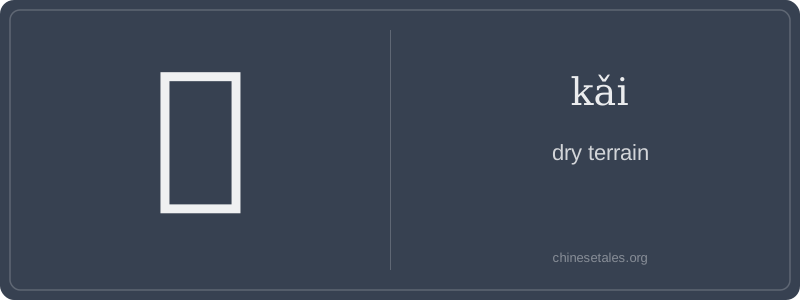
The earliest form of 垲 appears in bronze inscriptions (c. 1000 BCE) as a combination of 土 (tǔ, earth) on the left and 岂 (qǐ, originally a pictograph of a raised platform or elevated terrace) on the right. In oracle bone script, 岂 resembled a stepped mound — symbolizing height and exposure. Over centuries, the right-hand component stylized into the modern 岂 (with its distinctive ‘mountain + mouth’ shape), while the left remained firmly 土. Crucially, the nine strokes weren’t arbitrary: the four dots in 岂’s upper part evoke scattered dry clods; the horizontal strokes suggest cracked earth layers; even the final捺 (nà, right-falling stroke) mimics a sun-bleached ridge line.
This visual logic carried straight into meaning: elevated, exposed, rain-shadowed land — inherently dry. By the Han dynasty, 垲 appeared in geographical texts like the Hanshu•Dilizhi to describe the arid plains of Shaanxi and Gansu. Unlike generic dryness terms, 垲 always implied *topography*: high-altitude, wind-scoured, low-humidity terrain. Its rarity in modern speech reflects how precisely it maps onto real physical conditions — not a metaphor, but a geomorphological signature. Poets loved it because it packed climate, elevation, and texture into one compact glyph.
Imagine you’re hiking across the Loess Plateau in northwestern China — a vast, sun-baked expanse where wind has scoured away moisture for millennia. The ground cracks like ancient pottery, dust hangs in the air, and every step kicks up fine, dry earth. This is not just ‘dry land’ — it’s 垲: terrain so arid it feels *geologically thirsty*, a word that evokes barren openness, mineral starkness, and quiet resilience. It’s not casual weather talk (like 干燥 gānzào); 垲 is poetic, almost geological — reserved for landscapes, classical poetry, or formal geographical descriptions.
Grammatically, 垲 is almost always an adjective modifying nouns like 地 (dì, land), 原 (yuán, plain), or 野 (yě, wilderness). You’ll rarely see it alone or as a verb — it doesn’t mean ‘to dry out’ (that’s 晒 shài or 烘 hōng). Instead, it’s used descriptively: 垲地 (kǎi dì) means ‘arid terrain’, not ‘dry land’ in the everyday sense. Learners often mistakenly use it like 干 (gān) — but saying ‘这很垲’ sounds deeply unnatural; it’s not a standalone predicate. It belongs in compound nouns or literary phrases, never in colloquial speech or beginner sentences.
Culturally, 垲 carries a subtle dignity — it’s not ‘barren’ with negative connotations (like 荒 huāng), nor ‘deserted’ (like 荒凉 huāngliáng). Rather, it suggests *natural austerity*: land shaped by time and climate, not neglect. Classical poets used it to evoke solemn grandeur — think Du Fu describing the Northwest frontier. A common mistake? Confusing it with similar-sounding kǎi characters like 凯 (victory) or 恺 (cheerful) — zero semantic overlap! Pronunciation alone won’t save you; this character lives in the soil, not the celebration.