塍
Character Story & Explanation
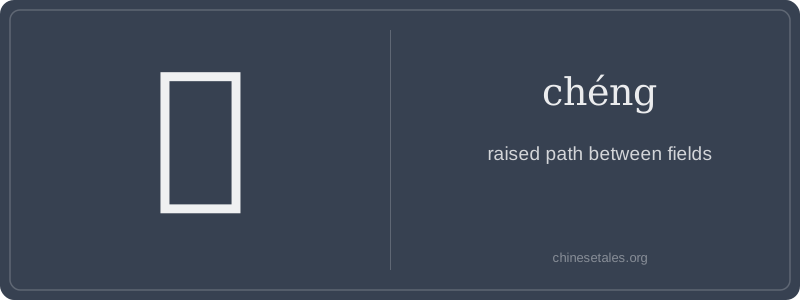
The earliest form of 塍 appears in Han dynasty bamboo slips as a compound ideograph: left side 土 (earth), right side 成 (chéng, 'to complete; become'). There’s no oracle bone version — it emerged later as a specialized agricultural term. Visually, the modern 13-stroke form preserves that logic: the 土 radical grounds it literally in soil, while the right-hand 成 — with its 戊 (wù, 'dagger-axe') top and 丁 (dīng, 'nail') base — suggests something deliberately *shaped* and *finished*: earth deliberately piled, compacted, and completed into a functional ridge. Its strokes flow downward and inward, mimicking how farmers press soil upward to form a firm, narrow crest.
By the Tang and Song dynasties, 塍 appears in agronomic texts like Chen Fu’s *Book of Farming* (《农书》) describing field systems in Jiangnan, where precise water management made every 塍 critical. Poets like Fan Chengda used it to evoke quiet, labor-honed harmony — not just terrain, but human intention made visible in earth. Its visual structure reinforces meaning: the 土 radical declares material origin; 成 signals purposeful construction. No accidental mound — this is earth *made into function*, a tiny monument to collective cultivation.
Think of 塍 (chéng) as the quiet, unassuming 'backbone' of traditional Chinese farmland — not a grand road, but a narrow, raised earthen path that snakes between rice paddies or wheat fields, keeping farmers’ feet dry and crops separated. It’s deeply tactile: you can almost feel the packed soil under your boots, hear the rustle of reeds growing along its edge. Unlike common nouns like 路 (lù, 'road') or 道 (dào, 'path'), 塅 is hyper-local and agrarian — it appears almost exclusively in regional dialects, classical poetry, or descriptive prose about rural landscapes. You’ll rarely hear it in daily conversation, but when you do, it carries poetic weight and geographic specificity.
Grammatically, 塍 functions strictly as a noun — no verb forms, no adjectival use. It’s often modified by measure words like 条 (tiáo, for long, thin things) or 一道 (yì dào, 'a strip of'), as in 一条塍 (yì tiáo chéng). Learners sometimes mistakenly treat it like a generic 'path' and plug it into urban contexts ('the subway 塍'), but that’s jarring — imagine calling a sidewalk 'a paddy-dike path' in English. It belongs where water, mud, and careful land division meet.
Culturally, 塍 embodies the ingenuity of ancient Chinese hydraulic farming: these paths doubled as irrigation boundaries and flood controls. Modern learners often misread it as 成 (chéng, 'to succeed') due to identical pronunciation and similar stroke density — but that swap turns 'the farmer walks along the raised path' into 'the farmer walks along success', which is charmingly absurd. Also, watch the radical: it’s 土 (tǔ, 'earth'), not 辶 (chuò, 'walking') — this character is rooted, not moving.