茔
Character Story & Explanation
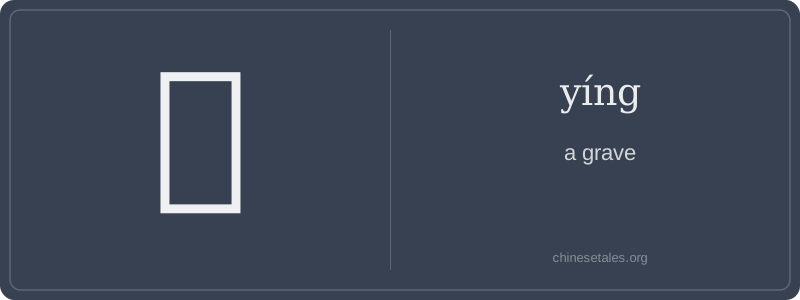
The earliest form of 茔 appears in bronze inscriptions from the Western Zhou (c. 1046–771 BCE) — not as grass, but as a pictograph resembling a rectangular mound with a crossbar inside (like an ancient ‘X’ marking the spot), flanked by two simplified ‘person’ symbols kneeling in mourning. Over centuries, the kneeling figures morphed into the top component (a variant of , now written as 艹 + 夺), while the mound softened into 冖 (a covering) and 盈 (fullness), suggesting a full, enclosed, honored space. By the Han dynasty, the grass radical 艹 was standardized on top — transforming the image from ‘people mourning a mound’ into ‘a mound nourished by living grass’, symbolizing enduring memory.
This visual evolution mirrors its semantic journey: from a physical burial site to a symbol of ancestral presence rooted in nature and time. Confucius himself referenced such plots in the Classic of Filial Piety, linking grave-tending to moral cultivation. Later poets like Du Fu wrote of ‘wind sighing over silent 茔’, using it to evoke both fragility and permanence. Crucially, the grass isn’t decoration — it’s active: the grave must be *alive* with vegetation to signify respect. A barren grave? That’s a cultural alarm bell — implying neglect, broken lineage, or spiritual abandonment.
Imagine walking with your Chinese grandmother through a quiet, mist-shrouded hillside in spring — not to pick wild chrysanthemums, but to tend her parents’ yíng: a simple, grass-covered grave marked by a weathered stone. That’s 茔 — not just any burial site, but a *tended*, *respected*, often *ancestral* grave, evoking reverence, quiet sorrow, and continuity. It’s poetic, formal, and rarely used in daily speech; you’ll see it in literature, epitaphs, or when speaking of family lineage — never in casual chat about funerals (for that, use 墓 or 坟). It carries the weight of filial piety, not clinical description.
Grammatically, 茔 is almost always a noun and appears in compound words (e.g., 祖茔, 茔地) or as the object of verbs like 扫 (sweep), 修 (repair), or 守 (guard). You won’t say ‘I have a 茔’ — instead: ‘我们去扫祖茔’ (We go sweep the ancestral graves). Learners sometimes misplace it as a verb or overuse it thinking it’s neutral like ‘grave’ in English — but it’s inherently literary and emotionally loaded. Also, it’s *never* used for modern cemeteries (公墓) or cremation sites — those are strictly off-limits for this character.
Culturally, 茔 implies land ownership and generational stewardship: a family’s sacred plot passed down, maintained, and visited during Qingming. Mistaking it for a generic ‘grave’ risks sounding archaic or even comically solemn — like calling your backyard ‘a hallowed sepulchral precinct’. And yes, its radical 艹 (grass) isn’t decorative: it visually roots the grave in earth and growth — death feeding life, literally covered in green.