塈
Character Story & Explanation
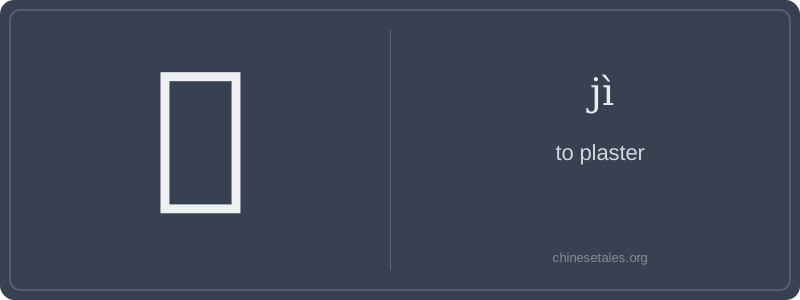
The earliest form of 塈 appears in bronze inscriptions as a compound pictograph: a radical resembling 土 (earth/soil) fused with a stylized hand holding a spreading tool — possibly a flat reed brush or smoothed bone scraper. Over centuries, the hand evolved into the right-side component 旣 (jì), which originally depicted a person eating from a vessel (indicating 'completion'), subtly reinforcing the idea of *finishing a surface*. By the Han dynasty clerical script, the left 土 had stabilized, while the right side simplified into today’s 旣 — no longer read for its original meaning, but preserved phonetically.
This evolution reflects how meaning shifted from 'finishing the surface with earth' to 'the act of applying plaster itself'. Classical references appear in the Rites of Zhou (Zhou Li), where 塈 describes finishing temple walls before ritual painting — underscoring its role as a sacred preparatory step. The character’s visual weight — heavy on the earth radical, refined in execution — mirrors its semantic role: grounding, smoothing, and preparing for higher artistry. Even today, conservators restoring Tang-dynasty murals use 塈 to describe the exact lime-clay layer beneath pigments — a linguistic time capsule of craft precision.
Forget 'plaster' as just slapping mud on a wall — 塈 (jì) is the ancient, precise verb for *applying fine clay or lime-based coating to smooth and seal surfaces*, especially in elite architecture. It’s not DIY home renovation; it’s ritual craftsmanship. You’ll almost never hear it in modern spoken Mandarin — it’s a literary, technical relic, surviving mostly in classical texts, historical restoration documents, or poetic descriptions of ancient buildings. Its feel is tactile, deliberate, and slightly ceremonial: think of artisans kneeling before palace walls during the Zhou dynasty, smoothing layers with bamboo trowels.
Grammatically, 塈 functions as a transitive verb — always followed by what’s being plastered (e.g., 塈墙 jì qiáng — 'to plaster the wall') — but crucially, it *never* takes aspect particles like 了 or 过 in contemporary usage. Learners mistakenly say '塈了' — but native speakers would instantly flag that as archaic or ungrammatical outside quotation. Instead, you’ll see it in passive constructions like '此墙已塈' ('this wall has been plastered'), where 已 signals completion, not 塈 itself.
Culturally, 塈 carries quiet prestige: it implies refinement, durability, and aesthetic control — unlike generic 涂 (tú, 'to paint/smear') or 抹 (mǒ, 'to wipe/spread'). A common mistake is overgeneralizing it to mean 'paint' or 'cover'; 塈 specifically denotes *fine, cohesive, binding earth-based application*. It’s also easily misread as 單 (dān, 'single') due to visual similarity — but that confusion would turn a sentence about wall restoration into a baffling declaration about singularity!