塅
Character Story & Explanation
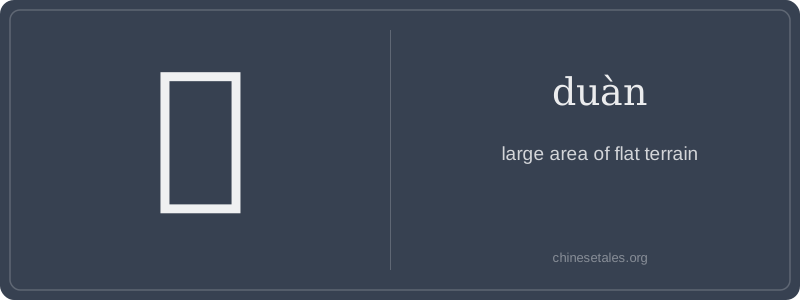
The character 塅 has no attested oracle bone or bronze script form — it’s a relatively late creation, first appearing in Song-era (960–1279) local gazetteers and Ming-Qing geographical manuals. Its structure is deliberately semantic: the left radical 土 (tǔ, ‘earth’) anchors it in geology, while the right component 段 (duàn) serves purely as a phonetic loan — borrowing the sound but *not* the meaning of 段 (‘segment’). Visually, it’s a clear ‘earth + duàn’ compound — no pictographic origin, no ancient pictograph. There are no strokes erased or added over millennia because it wasn’t inherited from ancient scripts; it was engineered for precision in technical writing.
Its meaning crystallized during the Ming dynasty when surveyors needed a term distinct from 平原 (píngyuán, ‘lowland plain’) and 高原 (gāoyuán, ‘high plateau’) — something *in between*: elevated but not mountainous, flat but not flood-prone, loamy but not sandy. Classical texts like the Yù Dì Zhì (Imperial Geography) use it to describe the terraced loess expanses around Tongchuan and Yan’an. The shape itself — earth plus sound — reflects how Chinese lexicography sometimes solves real-world descriptive gaps: when existing words don’t fit the land, you build a new one.
Here’s the truth no textbook tells you: 塅 (duàn) isn’t just ‘flat terrain’ — it’s *geologically specific*. It refers to a broad, elevated, gently sloping alluvial plain formed by ancient river deposits, typically found on the Loess Plateau of northwestern China. Think less ‘field’ and more ‘a vast, wind-sculpted tableland stretching to the horizon’ — quiet, stable, deeply fertile, and historically vital for millet farming. It carries a subtle sense of timelessness and quiet grandeur, rarely used in casual speech but appearing in geographical reports, historical texts, and poetic descriptions of the Northwest.
Grammatically, 塅 functions almost exclusively as a noun, usually preceded by a directional or descriptive modifier (e.g., 黄土塃 — ‘loess plateau’, 北部塃 — ‘northern plateau’). You won’t say ‘I walked on a 塅’ — instead, it appears in compound nouns or place names like 陇东塃 (Lǒngdōng Duàn, ‘Eastern Gansu Plateau’). Learners mistakenly treat it like 地 (dì, ‘ground’) or 平原 (píngyuán, ‘plain’), but 塅 implies elevation, stability, and geological age — not just flatness. It never stands alone in modern usage; it’s always contextualized.
Culturally, 塅 evokes ancestral resilience — this terrain sustained some of China’s earliest agrarian civilizations, yet remains sparsely populated today due to aridity and erosion. A common mistake is misreading it as 段 (duàn, ‘section’) — same pinyin, totally unrelated meaning! Also, its rarity outside specialized contexts means learners rarely encounter it until advanced geography or regional literature. Don’t force it into daily speech — let it live where it belongs: in maps, poems, and the quiet breath of northern China.