堽
Character Story & Explanation
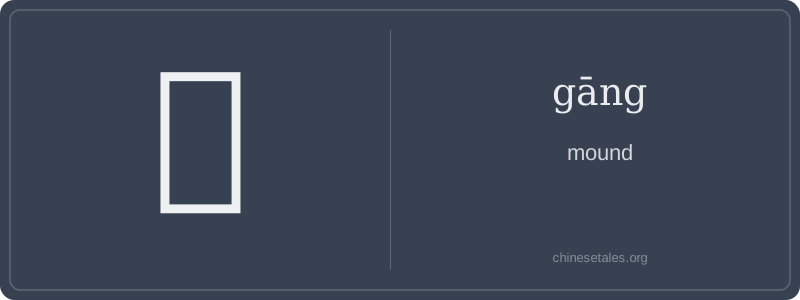
The earliest form of 堽 appears in bronze inscriptions as a pictograph showing two parallel horizontal lines (representing layers of packed earth) stacked atop a base that resembles a simplified ‘earth’ radical (土), sometimes with a central vertical stroke suggesting height or centrality. Over centuries, the upper elements evolved into the distinctive double ‘X’-like shape (two crossed strokes) above the 土 radical—visually echoing the layered, constructed nature of an artificial mound. By the Han dynasty, the structure stabilized into today’s form: two diagonal strokes crossing above two more diagonals (the ‘mound’s ridged profile’), all grounded firmly on 土.
This visual logic held meaning across millennia: in the Book of Rites, 堽 specifically denoted the raised earthen platform where Zhou dynasty nobles performed seasonal sacrifices; later, in Tang poetry, it appeared in phrases like ‘古堽’ (gǔ gāng, ancient mound) to evoke melancholy ruins. The character never shed its association with human intention—the mound isn’t natural erosion; it’s labor, memory, and reverence made visible in soil.
Think of 堽 (gāng) as the quiet, ancient cousin of more common 'mound' words like 坡 (pō, slope) or 丘 (qiū, hill). It doesn’t mean just any bump—it evokes a *deliberately built*, often *ritual or funerary* earthen mound: think burial tumuli, ancestral mounds, or ceremonial platforms from early Chinese civilization. Its feel is solemn, historical, and topographically precise—not scenic, but structural and symbolic.
Grammatically, 堽 is almost exclusively a noun—never a verb or adjective—and it rarely appears alone in modern speech. You’ll nearly always find it embedded in proper nouns (place names, historical sites) or classical compounds like 堽阜 (gāng fù), where it functions as a poetic, literary synonym for ‘elevated ground’. Learners might mistakenly try to use it conversationally ('There’s a mound over there!')—but native speakers would say 土堆 (tǔ duī) or 小山丘 (xiǎo shān qiū) instead. Using 堽 outside formal/historical contexts sounds archaic or even jarringly literary.
Culturally, 堽 carries deep resonance with early Chinese geomancy and ancestor veneration. In texts like the Shuōwén Jiězì (121 CE), it’s defined as ‘a high mound built for sacrifice’—linking earth, ritual, and lineage. A common learner trap? Confusing it with 阡 (qiān, field path) or 纲 (gāng, guideline), which share the same sound but zero semantic overlap. Remember: 堽 is *earth + ridge*, not *path* or *system*.