堼
Character Story & Explanation
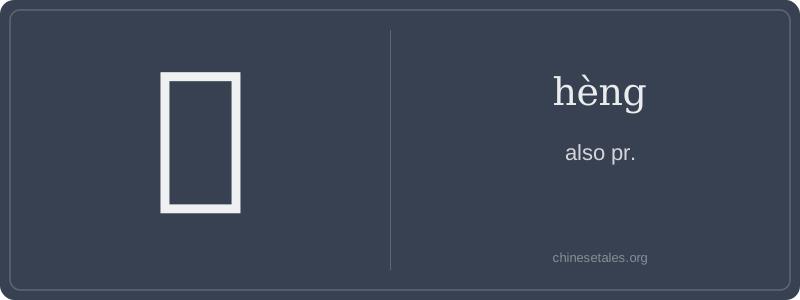
The earliest form of 堽 appears in late Warring States bamboo slips as a complex glyph combining 土 (tǔ, 'earth/soil') on the left and a stylized, doubled 彳 (chì, 'footstep') on the right — suggesting 'walking upon the same ground', i.e., shared action or identity. Over centuries, the left side solidified into the soil radical 土, while the right evolved from two parallel walking strokes into the elegant, interlocking curves of 更 (gēng) — though crucially, this was *not* the character 更, but a phonetic loan shape borrowed for its sound value. By the Han dynasty, clerical script flattened the curves, and the Tang standardization fixed the current form: 土 + 更, visually echoing both grounding and continuity.
Its meaning stayed remarkably stable: 'also', 'likewise', 'in the same way' — always relational, never standalone. Unlike 也, which could soften assertions ('He is kind, also'), 堽 appeared almost exclusively in parallel constructions, especially in Daoist and Legalist texts emphasizing cosmic or moral equivalence. The Zhuangzi uses it once — not in the main text, but in a disputed commentary layer — where it underscores ontological parity: 'life and death are one; waking and dreaming, 堽.' Here, the character’s earth-rootedness (土) subtly reinforces the idea that 'also' isn’t abstract logic — it’s grounded sameness, as tangible as shared soil.
Think of 堼 as Chinese linguistics’ version of a 'ghost word' — not quite dead, not quite alive. It’s a rare, archaic variant of 也 (yě, 'also'), preserved like a fossil in classical texts and scholarly footnotes. Unlike the cheerful, ubiquitous 也 that peppers modern speech ('I like tea, also coffee'), 堼 carries the hushed gravity of an inkstone in a Song dynasty study: it means 'also', yes — but only when you’re quoting Zhuangzi, transcribing Ming-era manuscripts, or decoding bronze inscriptions. You’ll never hear it spoken aloud in daily life; even native speakers may blink and ask, 'Wait — is that even a real character?'
Grammatically, it functions identically to 也 — as a sentence-final particle reinforcing continuity or equivalence — but only in hyper-formal, literary contexts. For example: '此道非独圣人行之,堽亦凡人可践也' (This path is not walked only by sages; common people, too, may tread it). Note how it appears before the final 也 — a subtle double reinforcement that would sound hilariously redundant in speech. Learners who try to swap it for 也 in conversation will be met with polite confusion — like using 'henceforth' instead of 'so' at a coffee shop.
Culturally, 堽 is a reminder that Chinese writing isn’t just a tool — it’s an archaeological stratum. Its survival isn’t due to utility, but to reverence for textual fidelity: editors kept it in transmitted classics to preserve original orthography, even as pronunciation and usage drifted. A common mistake? Assuming it’s a typo for 衡 (hèng, 'balance') or 横 (héng, 'horizontal') — both share the héng sound but zero semantic kinship. This character doesn’t balance anything. It doesn’t lie sideways. It simply *also* exists — quietly, stubbornly, outside time.