堳
Character Story & Explanation
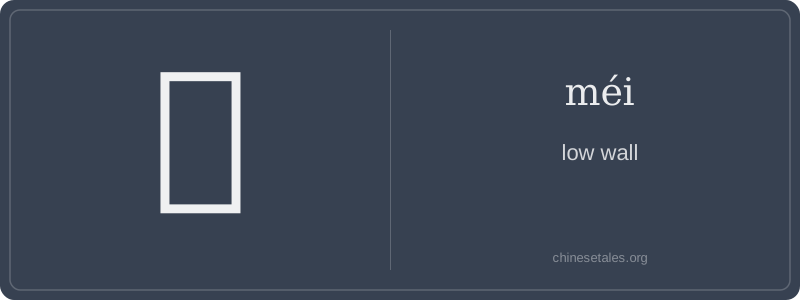
The earliest form of 堳 appears on Warring States bamboo slips as a compound pictograph: the left side was 土 (tǔ, ‘earth’), clearly drawn with three horizontal lines representing layered soil, and the right side resembled 莫 (mò), an early variant of 暮 (‘dusk’), but here used phonetically and visually to suggest ‘enclosure’ — two trees (艹) flanking a sun (日) sinking behind a hill (大). Over time, the ‘sun + hill’ simplified into 眉 (méi, ‘eyebrow’), retaining the sound méi while the earth radical remained firmly anchored on the left — hence the modern structure: 土 + 眉.
This evolution wasn’t arbitrary: eyebrows frame the eyes just as low earthen walls frame fields. In the *Book of Songs* (Shījīng), 堳 appears in fragments describing ‘the mound-wall by the eastern gate’ — not a fortress, but a gentle rise separating village from wildland. By the Song dynasty, scholars like Zhu Xi noted 堳 in commentaries on land tenure, emphasizing its role in defining familial plots. The character’s visual persistence — keeping 土 prominent and 眉 as both phonetic and semantic echo of ‘boundary line’ — reveals how deeply Chinese writing embeds landscape logic into script.
Think of 堳 (méi) not as a wall you’d lean against, but as the humble, almost invisible boundary between private and public space — a low earthen berm marking a family plot or enclosing a courtyard in ancient Shu (modern Sichuan). Its core meaning isn’t ‘wall’ in the grand sense like 墙 (qiáng), but specifically a *low, earthen, unfortified barrier* — often temporary, agricultural, or ritual. You won’t find it in modern newspapers or textbooks; it’s a fossilized term surviving mainly in classical poetry, regional dialects, and historical texts. Grammatically, it functions exclusively as a noun — never a verb or adjective — and almost always appears in compound words (like 堳埂 or 堳壟) rather than alone.
Learners rarely encounter 堳 in daily life, which is why it’s absent from the HSK list — but that makes mistaking it for similar-looking characters especially risky. For instance, confusing it with 没 (méi, ‘not’) would turn ‘the low wall collapsed’ into ‘it didn’t collapse’, flipping meaning entirely. Also, its pronunciation méi is identical to the common negative adverb 没, so tone and context are your only lifelines. In classical usage, 堳 often carries quiet dignity — describing boundaries that protect, separate, or sanctify without asserting power.
Culturally, 堳 reflects an agrarian worldview where land division wasn’t about conquest, but stewardship: low walls marked ancestral fields, irrigation channels, or sacred enclosures. Modern readers might misread it as ‘dull’ or ‘obsolete’, but in Tang dynasty poems or Ming-era local gazetteers, 堳 evokes precise, grounded geography — the kind of detail that made Chinese cartography astonishingly accurate over millennia. It’s a whisper of soil, slope, and silent demarcation.