堮
Character Story & Explanation
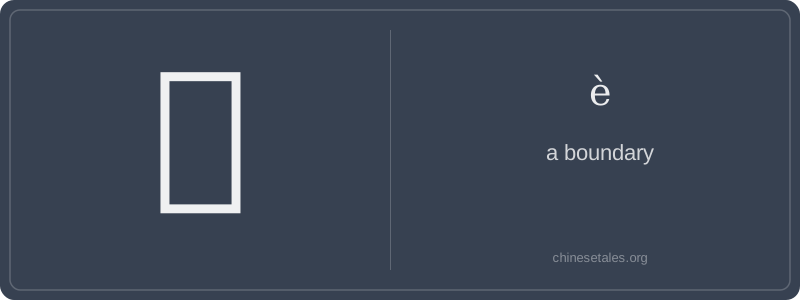
The earliest form of 堮 appears in bronze inscriptions from the Western Zhou period (c. 1046–771 BCE) as a compound pictograph: a simplified mound or raised earth (the radical 土, ‘earth’) topped by a stylized ‘signpost’ or upright marker — sometimes drawn as two parallel vertical strokes with a horizontal bar across, resembling a carved stone standing alone in open ground. Over centuries, the top element evolved from a pictorial signpost into the phonetic component 我 (wǒ), which here serves *only* as a sound clue (both 我 and 堮 were pronounced similarly in Old Chinese, around /*ŋaːlʔ/), while the 土 radical remained firmly anchored at the bottom — grounding the meaning in land and territory.
This visual logic held firm: earth + marker = a physical object placed *in* the earth to signify division. In the *Zuo Zhuan* and Han dynasty ritual texts, 堮 appears in contexts describing land grants to nobles — where the king would literally ‘set up the è’ to formalize the gift. The character never shifted toward abstract meanings like ‘limit’ or ‘scope’ (unlike 限 or 度); its semantic field stayed tightly bound to tangible, ceremonial demarcation. Even in late imperial poetry, 堮 retains its austere, monumental feel — always singular, always concrete, always silent except when invoked by historians or archaeologists.
Imagine you’re hiking along an ancient mountain trail in Shaanxi, and your guide suddenly stops at a weathered stone marker half-buried in moss. He taps it gently and says, 'This is a è — not just a line on a map, but a sacred threshold where one clan’s land ends and another’s begins.' That’s the soul of 堮: it doesn’t mean ‘border’ in the modern administrative sense (like 边境), nor does it imply political control — it’s a quiet, almost spiritual *boundary marker*, rooted in ritual geography and ancestral land rites. It carries weight, solemnity, and a sense of inviolable order.
Grammatically, 堮 is nearly extinct in spoken Mandarin and appears only in classical texts, historical inscriptions, or highly literary prose — never in daily conversation or HSK-level materials. You’ll never say ‘my house is near the è’; instead, you might read in a Tang dynasty stele: ‘立堮以辨疆’ (lì è yǐ biàn jiāng) — ‘erect boundary markers to distinguish territories.’ It functions exclusively as a noun, often paired with verbs like 立 (to erect), 刻 (to carve), or 設 (to establish). Learners mistakenly treat it like a synonym for 界 or 邊 — but doing so sounds archaic, jarring, or even comically overwrought, like calling a fence a ‘palisade’ in casual English.
Culturally, 堮 evokes early Zhou dynasty land demarcation practices, where physical markers (stone piles, carved trees, or earthen mounds) served as both legal evidence and cosmological anchors — aligning human space with cosmic order. Modern readers rarely encounter it outside epigraphy or academic history. Its biggest trap? Assuming it’s interchangeable with the far more common 界 (jiè); using 堮 instead of 界 in a sentence like ‘national boundary’ won’t be understood — it’s like quoting Shakespeare at a zoning board meeting.