堭
Character Story & Explanation
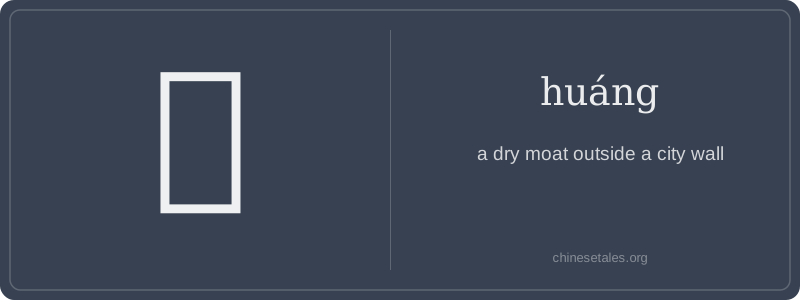
The earliest form of 堭 appears in bronze inscriptions of the Western Zhou (c. 1046–771 BCE), where it was written as a combination of 土 (tǔ, 'earth') on the left and 皇 (huáng, 'august, imperial') on the right — not as a pictograph of a moat, but as a *phonosemantic compound*: 土 signals the domain (earthworks), while 皇 provides pronunciation *and* conveys grandeur, authority, and ritual significance. Over centuries, the right-hand component simplified visually: the original 皇 — with its crown-like top (white) and royal platform (王) — gradually lost ornamental strokes, settling into today’s streamlined shape that still echoes imperial scale and deliberate design.
By the Warring States period, 堭 referred explicitly to the outermost dry defensive trench encircling major cities like Linzi or Handan — distinct from inner moats or irrigation ditches. In the *Zuo Zhuan*, it appears once in a military assessment: '城有堭,堭深三仞' ('The city has a 堭; the 堭 is three ren [~7.2 m] deep'). Its visual structure reinforces meaning: 土 anchors it in earthwork engineering, while 皇 subtly insists this isn’t mere digging — it’s sovereign infrastructure, a boundary drawn by mandate, not convenience.
Imagine standing on the crumbling ramparts of an ancient walled city at dusk — dust swirling, crows calling — and looking down into a wide, dry trench ringing the outer wall. That’s not just any ditch: it’s a 堭 (huáng), a deliberately excavated, waterless moat built for defense, distinct from the wet, flowing 护城河 (hù chéng hé). In classical Chinese, 堭 carries a quiet, archaic weight — it’s never used in modern spoken Mandarin, only in historical texts, archaeology reports, or poetic descriptions of ruined fortifications. You’ll never hear it in daily conversation, and it doesn’t appear in HSK lists for good reason: it’s functionally obsolete outside specialist contexts.
Grammatically, 堭 is a noun, always modified by classifiers like 座 (zuò) or 条 (tiáo), and almost always appears in compound phrases — rarely alone. Learners might mistakenly treat it like 河 (hé, 'river') or 沟 (gōu, 'ditch'), but 堭 specifically implies *dryness*, *intentional construction*, and *military perimeter function*. It’s not a natural gully or a drainage channel — it’s a strategic, empty void designed to slow attackers. Try using it without context, and native speakers will blink, then gently correct you with 护城河 or simply 壕 (háo, 'rampart trench').
Culturally, 堭 evokes the layered logic of pre-modern Chinese urban defense: walls, towers, gates — and this silent, sun-baked ring of earth. Its rarity makes it a subtle marker of textual sophistication; spotting it in a Tang poem or Song dynasty stele signals deep historical literacy. The biggest pitfall? Assuming it’s interchangeable with 壕 or 濬 (jùn, 'to dredge') — both share the 'earth' radical but diverge sharply in function and tone.