堨
Character Story & Explanation
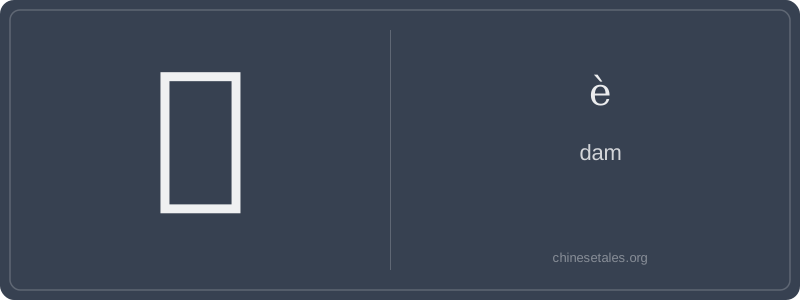
The earliest form of 堨 appears on Warring States bamboo slips as a simple yet vivid pictograph: two parallel horizontal lines (representing waterflow) interrupted by a vertical earthen mound — drawn as a thick, squat stroke with a slight bulge at the base, later standardized into the modern 土 radical at the bottom and the upper component evolving from 又 (a hand holding something) into the abstract top part. Over centuries, the 'hand' element simplified and stylized into the current 12-stroke upper section, while the 土 radical remained anchoringly literal — a visual promise: this is earth placed *across* water.
This character appears in the Guoyu (Discourses of the States) and early Han agricultural manuals describing flood control in the Yangtze delta, always paired with verbs like 修 (xiū, 'to repair') or 筑 (zhù, 'to build'). Its shape never lost its dual message: the upper part suggests deliberate intervention (the 'hand' or 'effort'), the lower part declares material (earth). Even in Tang poetry, when a poet writes '堨断春流' (è duàn chūn liú), he doesn’t mean 'the dam broke spring currents' — he means 'the earthen barrier gently parts the spring flow', honoring restraint over force.
At first glance, 堨 (è) looks like a quiet, sturdy character — and it is. Its core meaning is 'dam', but not the concrete monoliths we imagine today; in classical Chinese, it evokes a carefully built earthen barrier across a stream or riverbank, designed to control flow without violence — a subtle, almost diplomatic kind of containment. This nuance lingers: 堨 isn’t used for massive hydroelectric dams (that’s 大坝 dàbà), but for small-scale, often rural or historical waterworks — irrigation checks, floodbanks, or even metaphorical 'dams' against chaos.
Grammatically, 堨 functions almost exclusively as a noun, rarely as a verb (unlike English 'to dam'). You’ll encounter it in compound nouns (e.g., 水堨 shuǐ è, 'water dam') or place names — especially in southern China and ancient texts. Learners often misread it as 阿 (ā) or 恶 (è/wù), tripping over its tone or assuming it’s colloquial slang. It’s not: it’s literary, precise, and nearly obsolete in speech — appearing mostly in historical records, local gazetteers, or poetic descriptions of landscape.
Culturally, 堨 carries a quiet reverence for human harmony with water — not domination, but gentle guidance. Mistaking it for more common characters like 坝 (bà) erases this philosophical subtlety: 坝 implies engineering power; 堨 implies agrarian wisdom. Also, note its radical is 土 (earth/soil), not 氵 (water) — revealing that the ancient Chinese saw dams first as earthworks, not hydraulic systems. That soil-rootedness is key: it’s about what you *build*, not what you *control*.