堧
Character Story & Explanation
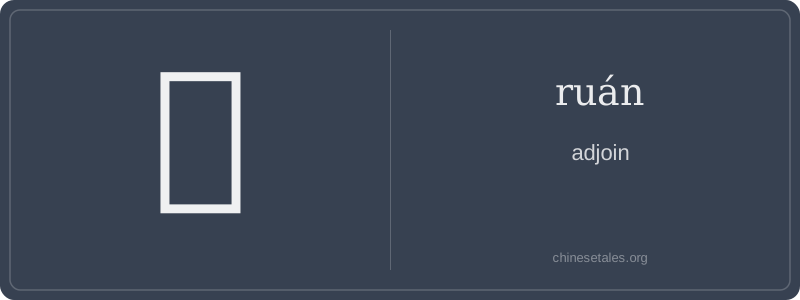
The earliest form of 堧 appears in Warring States bamboo slips as a compound ideograph: left side was 土 (tǔ, earth/soil), anchoring it in the physical world; right side resembled a stylized pair of interlocking ridges or bent arms (originally , later evolving into 元). That right-hand element wasn’t random — it visually echoed the shape of two elevated landforms meeting at a seam, like folded paper creases or adjacent cliff faces. Over centuries, the right side simplified and standardized into 元 (yuán), losing its ridge-like strokes but preserving the sense of foundational, paired presence — hence the modern form: 土 + 元.
This visual logic directly shaped its meaning: ‘earth’ plus ‘primary duality’ = landforms inherently sharing a border. In the Shuōwén Jiězì (121 CE), Xu Shen defines it as ‘two territories sharing a line — neither overlapping nor separate’. It appears in the Zuǒ Zhuàn describing the contested border between Jin and Qi states, where ‘堧地’ (ruán dì) meant ‘adjacent territory’, not ‘disputed land’. Its enduring power lies in how its shape enacts its meaning: two distinct elements — 土 and 元 — standing side-by-side, inseparable yet independent, just as the character itself demands.
Here’s the truth no textbook tells you: 堧 (ruán) isn’t just ‘adjoin’ — it’s the quiet, architectural whisper of things leaning in, touching at the edges, sharing a boundary without merging. Think of two ancient city walls meeting at a corner, or bamboo groves whose outer stalks brush shoulders in the wind. It conveys intimate proximity — not fusion, not overlap, but deliberate, respectful adjacency. In classical usage, it often appears in geographical or spatial descriptions where surfaces meet tangentially, like riverbanks converging or mountain ridges running parallel and close.
Grammatically, 堧 is almost exclusively literary and stative — it rarely takes aspect particles (了, 过) or serves as a verb in modern spoken Chinese. You’ll find it mostly in compound words (like 堧接 or 堧邻), or in formal writing describing territorial contiguity or structural continuity. Learners mistakenly try to use it like 靠 (kào, 'to lean on') or 接 (jiē, 'to connect'), but 堧 implies passive, inherent adjacency — no action, no intention, just existence in shared border-space.
Culturally, this nuance reflects a deeply spatial Confucian sensibility: relationships, like land, have defined edges that must be acknowledged — not crossed, not ignored, but honored precisely where they touch. Modern learners rarely encounter 堧 outside historical texts or legal-geographic documents, which is why it’s absent from HSK — yet recognizing it unlocks subtle precision in classical poetry and imperial boundary inscriptions. The biggest trap? Pronouncing it as ‘ruǎn’ (soft) — it’s ruán, with a level second tone, like ‘rwan’ with a calm, steady breath.