堠
Character Story & Explanation
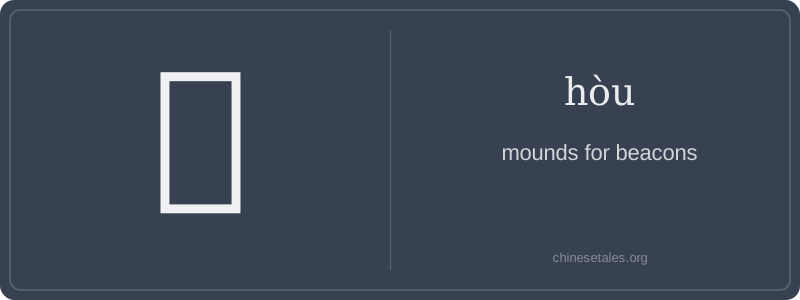
The earliest form of 堑 appears in Han dynasty seal script as a clear composite: left side 土 (a simplified mound with horizontal striations), right side 侯 — itself originally a pictograph of an archer under a shelter, later stylized into a marquis’s ceremonial headdress and bow. In bronze inscriptions, the whole character resembled a raised platform beside a watchtower silhouette. Over centuries, strokes streamlined: the ‘bow’ element in 侯 shrank to the top dot and curved stroke, while the ‘person’ inside became the vertical line and two dots. By the Kangxi Dictionary (1716), 堑 had settled into its current 12-stroke shape — elegant, balanced, and unmistakably grounded in earth.
Historically, 堑 wasn’t just infrastructure — it was narrative scaffolding. In Du Fu’s frontier poems, 堑 mounds appear as silent witnesses to soldiers’ exhaustion ('The beacon mounds stand cold, their fires long dead'). Tang generals recorded distances between 堑 in official logs — often exactly 30 li (≈15 km) — turning geography into rhythm. The character’s visual weight (12 strokes, centered radical) mirrors its function: immovable, deliberate, and built to outlast emperors. Even today, when archaeologists uncover a circular earthen ring on the Hexi Corridor, they call it a 堑 site — proof that this character still maps reality, not just language.
Think of 堑 (hòu) as the ancient Chinese version of a highway rest-stop beacon — but made of packed earth. It’s not just any mound: it’s a purpose-built, military-grade signal hill, placed at precise intervals along frontier roads to relay warnings via smoke or fire. The radical 土 (tǔ, 'earth') anchors its physical reality — these were literally earthen towers, often conical and over ten meters tall. The right side 侯 (hóu) isn’t just phonetic; it carries the nuance of 'watching' or 'guarding', like a noble overseer (the original meaning of 侯 was 'marquis' — a high-ranking regional guardian). So 堑 = 'earth + vigilant authority' = a strategically placed mound for surveillance and signaling.
Grammatically, 堑 is almost exclusively a literary noun — you’ll never hear it in daily speech or see it on WeChat. It appears only in classical poetry, historical texts, or evocative modern prose describing frontier landscapes. You won’t say 'I saw a 堑'; you’ll read 'ancient 堑 stood silent beneath the moon'. It’s uncountable and never takes measure words like 个; instead, it pairs with classifiers like 座 (zuò, for structures) or simply appears bare in poetic lines. Learners mistakenly treat it like a common noun — but it’s more like 'battlement' in English: real, historical, and stylistically elevated.
Culturally, 堑 embodies China’s layered defense philosophy: low-tech, terrain-integrated, and deeply communal. Unlike stone fortresses, these mounds required coordinated labor across villages — each one a testament to collective vigilance. A common learner trap? Confusing it with 候 (hòu, 'to wait') or 侯 (hóu, 'marquis'), both visually similar. But 堑 has no time-related or honorific sense — it’s purely topographic and functional. Its rarity today makes it a quiet signature of literate precision: if a writer chooses 堑, they’re invoking history, solitude, and the wind-scoured edge of empire.