垴
Character Story & Explanation
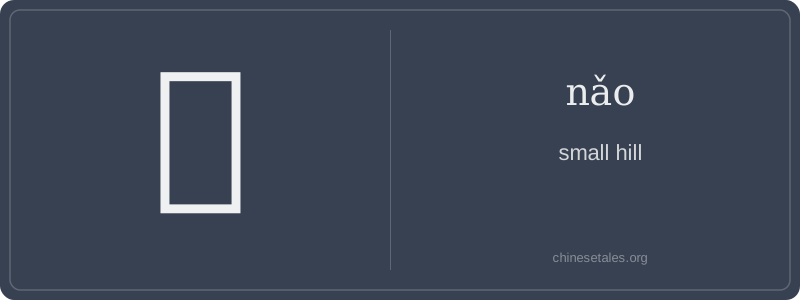
The earliest form of 垴 appears in late bronze inscriptions as three stacked 土 (tǔ, 'earth') glyphs — not side-by-side, but vertically aligned like sedimentary layers settling over centuries. Imagine ancient scribes carving into wet clay: each 土 represents a mound built by hand — perhaps a burial tumulus, a ritual platform, or a farmer’s terraced ridge. Over time, the three 土 fused visually: the top one shrank slightly, the middle widened, and the bottom gained a slight hook on the right stroke — evolving into today’s compact, symmetrical nine-stroke character. No radical 'change' occurred; the radical *is* the meaning — tripled for emphasis.
This visual repetition wasn’t mere decoration — it encoded semantic intensity. In classical texts like the *Shuōwén Jiězì* (c. 100 CE), 垴 is defined as 'high earth' (gāo tǔ), but contextually it meant 'earth piled high enough to be named'. It appears in Tang dynasty poetry describing frontier landscapes ('the wind sweeps across the silent 垴') and Ming-era local gazetteers documenting loess plateau villages. The triple-earth motif echoes Daoist ideas of layered harmony — heaven above, humanity in the middle, earth below — yet here, all three layers are *earth*, grounding the character in tangible, worked soil rather than cosmic abstraction.
垚 (nǎo) is a poetic, almost literary word for 'small hill' or 'mound' — think of gentle earthen rises in rural landscapes, not jagged mountains. It carries an archaic, earthy warmth, like stepping onto sun-warmed soil after rain. You’ll rarely hear it in daily conversation; instead, it appears in place names (especially in northern China), classical poetry, and descriptive writing where precision and texture matter. Unlike common words like 山 (shān, 'mountain') or 丘 (qiū, 'hill'), 垴 emphasizes low, rounded, human-scale elevation — often formed by accumulated earth, not geology.
Grammatically, 垴 functions as a noun only, usually unmodified by measure words like 座 or 个. You won’t say *一座垚* — that’s unnatural. Instead, it appears bare or in compounds: 垚地 (yáo dì, 'mound land'), or paired with directional terms like 垭口 (yà kǒu) — wait, no, that’s different! (A classic trap — see 'similar' below.) In speech, it’s almost always part of a proper noun: e.g., 马家垚 (Mǎjiā Yáo), a village name. Learners mistakenly try to use it like a generic synonym for 'hill', but native speakers instantly sense the oddity — it’s like calling a garden gnome 'a diminutive statuary artifact' at a BBQ.
Culturally, 垴 reflects how Chinese geography terms encode subtle distinctions in terrain formation. Its triple-土 structure isn’t just decorative — it signals accumulation, layering, and stability. Mispronouncing it as náo (second tone) or nà (fourth tone) is common, but nǎo (third tone) is non-negotiable — the dipping tone mirrors the shape of a small, rounded rise. And yes, its absence from HSK isn’t oversight: it’s preserved in regional speech and toponyms, not classroom drills — a quiet reminder that Mandarin’s richness lives beyond standardized lists.