堎
Character Story & Explanation
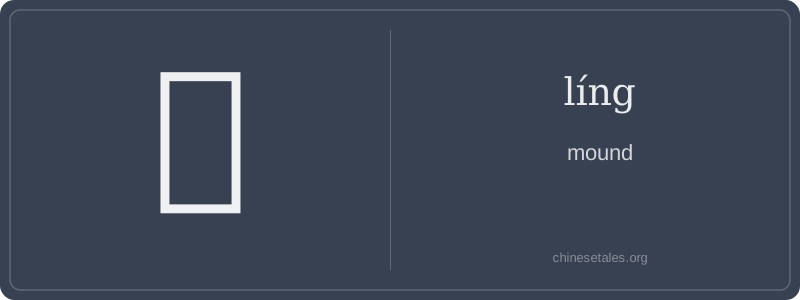
The earliest form of 堎 appears in bronze inscriptions as a pictograph showing two small, rounded humps atop a horizontal base line — unmistakably representing twin earthen mounds rising from flat ground. Over centuries, the base solidified into the 土 (tǔ, 'earth') radical at the bottom, anchoring its meaning in soil and terrain. The top evolved from stylized twin peaks into the simplified 令 component — originally unrelated phonetically, but later adopted for its sound (líng), turning 堎 into a phono-semantic compound: 土 + 令 = 'earth-related thing pronounced líng'.
This character appears in early texts like the *Shuō Wén Jiě Zì* (121 CE), where Xu Shen defines it as 'a small hill' — emphasizing modesty and natural formation, distinct from artificial terraces (tái) or fortified hills (bǎo). In classical poetry, 堎 often appears alongside words like 丘 (qiū, 'hillock') and 阜 (fù, 'gentle slope'), forming delicate topographic triads that evoke serene, agrarian landscapes. Its visual rhythm — grounded by 土, crowned by the balanced symmetry of 令 — mirrors the very mound it names: stable, unassuming, and quietly enduring.
Think of 堎 (líng) as a quiet, ancient hill that never made it onto modern maps — or HSK lists. Its core meaning is 'mound' or 'small earthen hill', evoking something natural, gentle, and slightly forgotten: not a dramatic mountain (shān), not a cultivated field (tián), but the soft, rounded swell of earth you might find beside an old road or temple gate. It carries a poetic, classical weight — you’ll rarely hear it in daily chatter, but it lingers in place names, historical texts, and literary descriptions of landscape.
Grammatically, 堎 functions almost exclusively as a noun, often appearing in compound words (like 堎阜 or 堎丘) or as part of proper nouns (e.g., place names such as 马堎村). It does not take aspect markers (了, 过) or function as a verb — a common learner mistake is trying to 'mound' something with it (*wǒ líng le yī duī tǔ). It’s also not used alone in speech; saying just 'lǐng' will likely get you a blank stare — people say 小山包 or 土堆 instead. Its presence signals literary register or geographic specificity.
Culturally, 堎 reflects how classical Chinese encoded subtle topography: not just height, but shape, origin, and human interaction with land. In ancient times, mounds were ritual sites, burial markers, or defensive earthworks — so 堎 quietly carries echoes of ancestral reverence and territorial memory. Learners often misread it as 玲 (líng, 'jade sound') due to identical pronunciation and visual similarity — but while 玲 chimes, 堎 rises silently from the soil.