堍
Character Story & Explanation
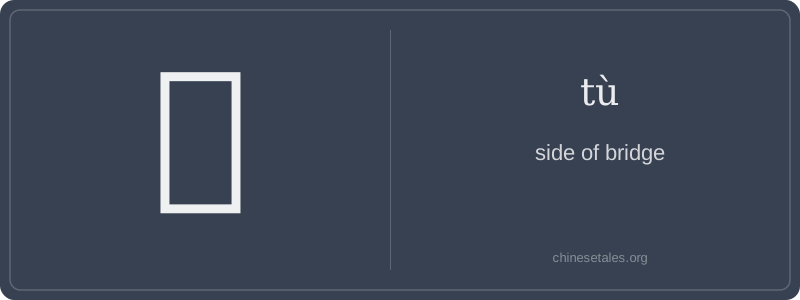
Oracle bone and early bronze inscriptions show no direct precursor for 堍 — it’s a relatively late creation, emerging during the Warring States to Han periods as bridge-building advanced. The modern form crystallized by the Eastern Han: the left-side 土 radical was standard for earthworks, while the right component evolved from a simplified depiction of 'a platform extending beyond a structure' — later stylized into 余, whose original bronze form resembled stacked beams with an overhang. Over centuries, clerical script flattened the strokes, and regular script solidified the 11-stroke balance: four horizontal lines in 土 (ground), then seven strokes in 余 — echoing the layered soil strata of a real embankment.
By the Tang dynasty, 堍 appears in hydraulic texts like the *Tongdian*, describing canal maintenance: '桥堍培土以固基' ('reinforce the bridge’s 堍 with packed earth to stabilize its foundation'). Its meaning never broadened — unlike similar characters that drifted into abstract uses, 堍 stayed stubbornly literal, tied to masonry and hydrology. Even today, local dialects in Zhejiang and Jiangsu preserve its pronunciation as tù (not yú), honoring its functional origin over its component’s sound — a rare case where the whole overrides the part.
Think of 堍 (tù) as the quiet, unsung 'shoulder' of a bridge — not the span itself, not the piers beneath, but the sloped earthen embankment where the bridge meets dry land. It’s a highly specific, architectural term rooted in traditional Chinese civil engineering: 土 (tǔ, 'earth/soil') on the left grounds it literally and physically, while the right side, 余 (yú, 'remainder, surplus'), hints at what’s left over after the main structure is built — the transitional zone between water and road. This isn’t abstract; it’s tactile, topographic, and deeply regional.
Grammatically, 堍 is almost always a noun and rarely stands alone — you’ll encounter it in compound terms like 桥堍 or 堍头. It never takes aspect markers (了, 过) or pluralizers (们); it’s a fixed, concrete noun like 'abutment' in English engineering jargon. Learners often misread it as tú (like 兔 'rabbit') and try to use it metaphorically — but no: this word belongs exclusively to bridges, canals, and historical infrastructure. You won’t find it in modern urban descriptions unless referencing heritage sites or classical poetry.
Culturally, 堍 carries a subtle poetic weight — it’s where journeys begin and end, where land reasserts itself after crossing water. In Jiangnan region literature, 堍头 (qióu tóu) evokes misty dawn scenes: fishermen untying boats, peddlers setting up stalls — liminal, human-scaled moments. A common mistake? Confusing it with 圩 (wéi, 'levee') or 墟 (xū, 'market ruin'); both share the 土 radical but lack the precise bridge-connection. Also, don’t force it into HSK-level sentences — it simply doesn’t belong there.