垩
Character Story & Explanation
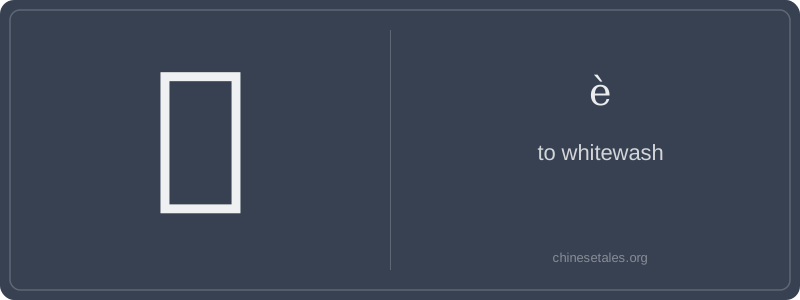
The earliest form of 垩 appears in bronze inscriptions as a pictograph showing a hand holding a brush over a mound of earth — not abstract, but literal: a worker applying white clay to soil or stone. The top component evolved from a simplified representation of ‘white powder’ (originally resembling scattered dots or granules), while the bottom 土 radical anchored it firmly in the realm of earth and minerals. Over centuries, the granular top condensed into the modern ‘亞’-like shape (not the character 亞, but a stylized glyph for ‘powdered lime’), and the 土 radical remained unchanged — a constant reminder that this whitewash came from the ground, not the factory.
This visual logic shaped its meaning: 垩 wasn’t about color per se, but about *application of processed earth* for cleansing or marking. In the Zhuangzi, the famous parable of the ‘Master Carpenter Shi’ mentions ‘以垩塗鼻’ (using 垩 to coat the nose) — a test of skill requiring perfect, dust-free precision. Here, 垩 isn’t decorative; it’s a medium for mastery. Its enduring link to ritual, burial, and craftsmanship kept it alive in classical prose, even as colloquial speech replaced it with simpler verbs — preserving 垩 as a linguistic fossil of pre-industrial material culture.
Imagine a quiet Ming-dynasty temple courtyard at dawn: a master craftsman dips a wide brush into a thick, chalky slurry — not paint, but finely ground white limestone mixed with glue — and sweeps it across the weathered wooden beam above the gate. With each stroke, he isn’t just covering wood; he’s performing è: whitewashing as ritual purification, erasure of decay, renewal of sacred space. That’s the soul of 垩 — not mere painting, but deliberate, functional whitening using mineral-based lime or chalk. It carries weight: this is restoration, not decoration.
Grammatically, 垩 is almost always a verb (rarely a noun for the whitewash itself), used transitively: you è something — a wall, a tomb, a beam. It rarely appears alone; it’s embedded in formal or literary contexts: ‘垩壁’ (whitewash the wall), ‘垩墓’ (whitewash a tomb). Learners often mistakenly treat it like 涂 (tú, 'to smear') or 刷 (shuā, 'to brush'), but those are neutral and colloquial; 垩 implies substance, purpose, and tradition. You wouldn’t 垩 your living room — you’d 粉刷 it.
Culturally, 垩 evokes antiquity and austerity: classical texts use it for tombs (symbolizing purity and separation from the profane) or Confucian lecture halls (clean slate for learning). Modern usage is rare — mostly in historical reenactments, conservation work, or literary writing. A common mistake? Using it where 白化 (báihuà, 'to whiten chemically') or simply 漂白 (piǎobái, 'to bleach') would be accurate. 垩 is earthy, manual, and ceremonial — never industrial or casual.