堉
Character Story & Explanation
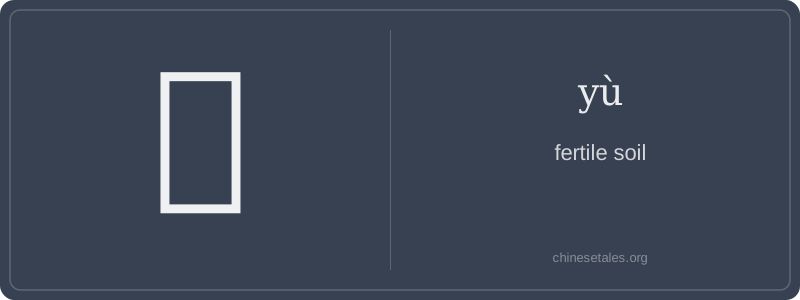
The earliest form of 堉 appears in bronze inscriptions as a vivid pictograph: a square 'earth' base (土) topped by two curved, wavy lines — not random strokes, but stylized depictions of *moist, layered strata*, like rich topsoil over damp subsoil. Over centuries, those wavy lines hardened into the two horizontal strokes above the 土 radical, while the bottom remained unmistakably earth — grounded, literal, elemental. The character never simplified; its form stayed remarkably stable, a testament to how deeply the ancients linked visual clarity with agricultural truth.
By the Warring States period, 堉 was already used in texts like the *Guoyu* (Discourses of the States) to describe the 'nourishing earth' granted by heaven to virtuous rulers — linking fertility to moral legitimacy. In Han dynasty agricultural manuals, it specifically denoted topsoil with high organic content, ideal for millet and wheat. Even today, soil scientists use it technically, but poets prefer it for its resonance: the very shape — earth holding layers — mirrors how fertility isn’t surface-deep, but cumulative, patient, and profoundly vertical.
Think of 堉 (yù) not as just 'fertile soil' but as the ancient Chinese idea of *earth that breathes life* — rich, dark, crumbly, humming with worms and promise. It’s not generic dirt; it’s the kind of soil that makes poets sigh and farmers pray. You’ll rarely see it alone in modern speech — it’s a literary, almost poetic word, like 'loam' or 'humus' in English: precise, evocative, and quietly powerful.
Grammatically, 堉 functions almost exclusively as a noun, often in compound words or classical-style phrases. You won’t say 'This soil is 堉' — instead, you’ll encounter it in terms like 堉土 (yù tǔ, 'fertile earth') or in literary descriptions: 'the riverbank’s 堉 was black and deep'. It never appears as a verb or adjective, and it doesn’t take aspect particles (了, 过) or modifiers like 很 — that’s a classic learner trap. If you try to say 'very fertile soil', you’d use 肥沃 (féiwò), not 堉.
Culturally, 堉 carries the weight of agrarian reverence — it’s the soil that nourished China’s earliest millet fields and Shang dynasty rituals. Modern learners sometimes misread its radical (土) and assume it’s common or colloquial, but it’s actually quite rare outside historical texts, poetry, or soil-science terminology. Its silence in daily speech is part of its charm: it’s a whisper from the land itself — quiet, deep, and untranslatable without reverence.