堈
Character Story & Explanation
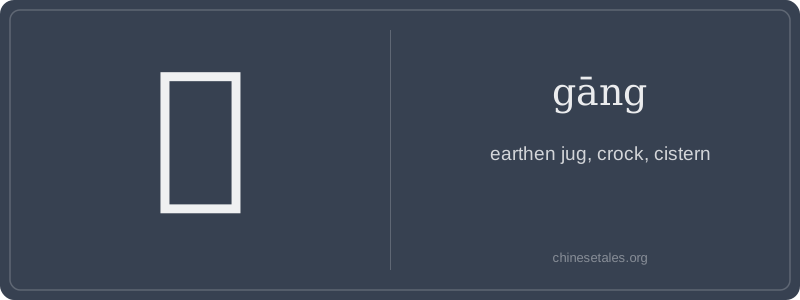
The earliest form of 堈 appears in Han dynasty seal script and early clerical inscriptions — not oracle bone, but close enough in spirit. Visually, it’s a masterclass in semantic stacking: the top part, 亢 (kàng), originally depicted a person standing tall with arms raised (like a ritual posture), later stylized into two horizontal strokes over a bent line. Beneath it sits 土 (tǔ), the earth radical — unmistakable, grounding, literal. Over centuries, 亢 softened into its modern simplified shape, while 土 remained stubbornly, beautifully earthy — no decorative flourishes, just raw, unglazed soil.
This structure tells a story older than porcelain: the vessel doesn’t dominate the earth — it *rises from it*. In classical texts like the *Qimin Yaoshu* (c. 540 CE), 堈 appears alongside descriptions of fermenting soy sauce and storing rainwater, always tied to land stewardship and seasonal patience. Its shape mirrors its function: wide mouth for filling, narrow base for stability, thick walls for insulation. Even today, potters in Fujian say, 'A true 堈 must breathe — if it doesn’t sweat when cool water fills it, it’s not real.' That breath? It’s the character’s soul — written with earth, sounding like strength (gāng), holding time itself.
At first glance, 堈 (gāng) feels like a quiet relic — an earthenware jug, crock, or cistern. But don’t mistake its rustic simplicity for irrelevance: in southern Chinese dialects (especially Min and Hakka), 堈 is still alive in daily speech, evoking the tactile warmth of sun-baked clay, the cool hush of water stored underground, and the slow rhythm of pre-industrial domestic life. It’s not abstract — it’s *heavy*, *porous*, *earthy*. You won’t find it on menus or subway signs, but you’ll hear it from elders describing how grandmother kept pickled mustard greens in a 堈 buried in the courtyard shade.
Grammatically, 堈 functions strictly as a concrete noun — no verbs, no adjectives, no measure words tacked on without care. It rarely appears alone; it’s almost always paired with classifiers like 口 (kǒu, for hollow vessels) or 个 (gè, generic), or embedded in compound nouns like 瓦堈 (wǎ gāng, tile-lined crock). Learners often mispronounce it as ‘gāng’ with a flat tone instead of the correct first tone — a subtle slip that could make listeners think you’re saying 刚 (gāng, 'just') or even 缸 (gāng, 'tank'), which *is* more common but carries industrial connotations.
Culturally, 堈 reveals how Chinese lexical richness lives in regional soil, not just standard Mandarin. Its absence from HSK isn’t a mark of obsolescence — it’s a sign that some truths are too local, too material, to be standardized. Mistake it for 缸? You’ll conjure stainless steel reservoirs, not hand-coiled clay. Forget the radical 土 (earth) at the bottom? You’ll miss the whole point: this vessel *is* earth — shaped, fired, and made sacred by use.