堄
Character Story & Explanation
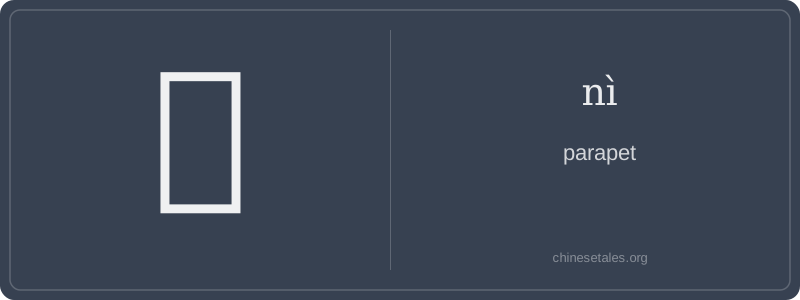
The earliest form of 堄 appears in bronze inscriptions of the late Zhou dynasty: a simple yet vivid pictograph — two parallel horizontal lines (representing the top and base of a low wall) stacked above the 'earth' radical (土), with a short vertical stroke between them suggesting a merlon or gap. Over centuries, the upper line thickened into the '冖' (cover) component, while the central stroke evolved into the '八' shape seen today — not the number eight, but a stylized depiction of the alternating solid (merlon) and open (crenel) pattern of defensive parapets. By the Han dynasty clerical script, the character had stabilized into its modern structure: 土 + 冖 + 八 — earth-based, covering, segmented.
This visual logic mirrors its semantic journey: from a concrete, tactile feature of walled cities (as described in the Mozi, where defensive architecture is treated with engineering rigor), to a literary motif in Tang poetry — Du Fu once wrote of 'broken 堄 under cold moonlight', using it to symbolize fallen sovereignty. Its meaning never broadened; unlike 墙 (qiáng, 'wall'), which can mean any barrier, 堄 remained surgically precise: only the uppermost defensive ledge. Even in the Shuowen Jiezi (100 CE), Xu Shen defines it unambiguously as 'the low wall atop a rampart for sheltering soldiers' — a definition unchanged for two millennia.
Imagine standing on the crumbling ramparts of an ancient city wall at dusk — wind whipping your hair, stones worn smooth by centuries of sentries’ boots. There, just above the crenellations, runs a low protective barrier: not tall enough to hide behind, but just high enough to shield archers from enemy arrows. That barrier is a nì — 堄. It’s not a full wall, nor a gate, nor a tower; it’s that specific, functional ledge — austere, military, architectural. In Chinese, 堄 carries no emotional warmth; it’s a technical term, almost archaeological — you’ll encounter it in historical texts, restoration reports, or classical poetry describing fortress defenses.
Grammatically, 堄 functions exclusively as a noun, never as a verb or adjective. It rarely appears alone: you’ll almost always see it in compounds like 女墙 (nǚ qiáng — 'lady wall', i.e., parapet) or 城堄 (chéng nì — 'city parapet'). Learners sometimes misread it as a variant of 泥 (ní, 'mud') due to the 'nì' sound and the '土' radical — but 堄 has zero connection to earth or sludge; it’s pure stone-and-strategy. Using it in casual speech ('Let’s sit on the 堄!') would sound as odd as saying 'Let’s lounge on the battlement!' in English — technically correct, but jarringly archaic.
Culturally, 堄 evokes the quiet authority of Ming dynasty fortifications or Tang frontier garrisons — places where architecture served survival, not aesthetics. Modern usage is sparse and deliberate: if a historian writes of 'the eroded 堄 of Jiayuguan', they’re invoking precision, not poetry. Mistake it for 尼 (ní, 'nun') or 逆 (nì, 'to oppose'), and you’ll accidentally conjure nuns or rebellion atop your city wall — a delightful but disastrous mix-up.