堀
Character Story & Explanation
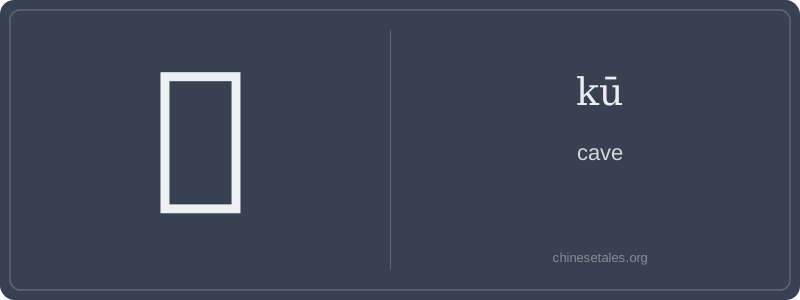
The earliest form of 堀 appears in bronze inscriptions as a simple pictograph: a square enclosure (representing a bounded space) with horizontal strokes inside — visual shorthand for 'earth removed from a defined area'. Over centuries, the top evolved into the modern 'qu' shape (actually a stylized representation of layered strata), while the bottom solidified into 土 (tǔ, 'earth'), anchoring its meaning in soil and excavation. The 11 strokes reflect this duality: the upper part (the 'qu' component) has 7 strokes — echoing the layered excavation — and the lower 土 adds 3 strokes plus one connecting stroke, totaling 11. Interestingly, the 'qu' part is *not* the same as the character 曲 (qū, 'bend'); it’s a unique, fossilized glyph tied only to excavation.
In the Shuōwén Jiězì (121 CE), Xu Shen defined 堀 as 'a pit dug deep into earth' — emphasizing intentionality and depth. By the Song dynasty, it appeared in military manuals describing defensive earthworks, and in Daoist texts metaphorically for 'the hidden root of vitality'. Its visual logic is brilliant: 土 beneath, and above it, a glyph suggesting containment + layering = 'earth deliberately hollowed out'. That visceral link between shape and action makes it a rare surviving example of functional pictography in late-stage character evolution.
堀 is a quiet, ancient word for 'cave' or 'excavated hollow' — not the cozy grotto of travel brochures, but the raw, earthy act of digging into soil to make a cavity. It carries a tactile, almost geological weight: think of a fox’s burrow, a wartime bunker, or an archaeological trench. Unlike common synonyms like 洞 (dòng) — which is neutral and versatile — 堀 feels archaic, literary, or regionally specific (still used in some southern dialects and classical poetry). You’ll rarely hear it in daily Mandarin; it’s more likely to appear in historical texts, place names, or poetic metaphors for concealment or origin.
Grammatically, 堀 functions as a noun — never a verb — and almost always appears with modifiers: 深堀 (shēn kū, 'deep cave'), 古堀 (gǔ kū, 'ancient excavation'), or in compounds like 堀地 (kū dì, 'excavated ground'). Crucially, it’s *not* interchangeable with 坑 (kēng), though both mean 'pit': 坑 implies accident or trap, while 堀 implies intentional, often skillful, earth removal. Learners sometimes misread it as 窟 (kū, also 'cave') — but that one has 穴 (cave) on top, signaling natural formation, whereas 堀’s 土 radical roots it firmly in human labor.
Culturally, 堀 evokes early agricultural society — the moment humans first dug into earth not just for roots, but for shelter, storage, or ritual. It appears in excavated Warring States bamboo texts describing fortification trenches, and later in Tang poetry comparing a hermit’s retreat to a secluded 堀. Modern learners rarely need it conversationally, but recognizing it unlocks layers of classical imagery — and prevents mistaking it for homophones like 哭 (kū, 'to cry') or 枯 (kū, 'withered'), where tone and context are everything.