埽
Character Story & Explanation
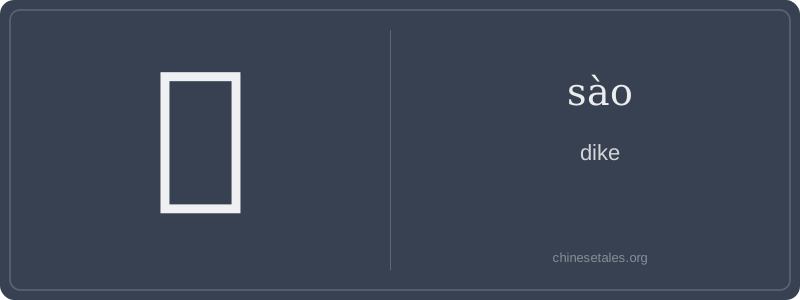
The earliest form of 埽 appears in Han dynasty bamboo slips and seal script, not oracle bones — it’s relatively late. Visually, it’s a masterclass in semantic + phonetic fusion: the left side 土 (tǔ, ‘earth’) anchors meaning, while the right side 叚 (jiǎ, an archaic variant of 假, ‘borrowed’ or ‘temporary’) hints at pronunciation *and* function — because these dikes were literally ‘borrowed’ from nature (willow, reeds, soil) and meant to be temporary. Stroke-by-stroke, it evolved from a more complex 叚 (with extra strokes) into today’s streamlined 11-stroke form: 土 (3 strokes) + 叚 (8 strokes), where 叚 itself simplifies from 古 + 卩 — evoking ‘ancient ritual gesture’, nodding to the ceremonial coordination required to build them.
By the Song and Ming dynasties, 埽 became standardized in hydraulic texts like the Treatise on River Management (河防通议). Its meaning never drifted — it stayed fiercely specific to these composite, brushwood-reinforced earthen barriers. Intriguingly, its visual weight (that heavy 叚 on the right) mirrors its physical role: a dense, interlocked structure resisting water pressure. Even today, when historians describe how the Yellow River was tamed, 埏 appears not as metaphor, but as technical noun — a quiet testament to vernacular engineering wisdom encoded in ink and clay.
Imagine standing on a rain-lashed riverbank in ancient China, watching villagers frantically reinforce a crumbling earthen barrier — not with concrete or steel, but with woven reeds, bundled straw, and packed soil. That barrier? A 埽 (sào): a uniquely Chinese, low-tech, life-saving dike built *on the fly* during floods. Unlike modern ‘dikes’ (堤 dī) or ‘levees’ (坝 bà), 埏 carries visceral urgency — it’s temporary, handmade, and born of crisis. It’s not just infrastructure; it’s communal resilience made visible.
Grammatically, 埽 is almost always noun-only and appears in formal, historical, or technical contexts — never in casual speech. You’ll find it in phrases like 柳埽 (liǔ sào, willow-reed dike) or in official flood-control reports. Learners sometimes misread it as sǎo (‘to sweep’) due to the shared sound, but that’s a critical error: 埽 has zero connection to cleaning — confusing them would turn ‘the willow dike held’ into ‘the willow swept’, nonsensical and dangerous! Also, it never stands alone: you’ll never say ‘I built a 埽’ — it always appears in compound terms.
Culturally, 埽 embodies the ingenuity of pre-modern hydraulic engineering — especially along the Yellow River, where silt-heavy floods demanded adaptive, biodegradable solutions. Modern readers may miss its gravity: this isn’t poetic imagery; it’s a term steeped in centuries of flood trauma and triumph. Mistaking it for a generic ‘dike’ erases its specificity — it’s not just any barrier, but one woven from willow branches and earth, anchored by human hands against the current.