埼
Character Story & Explanation
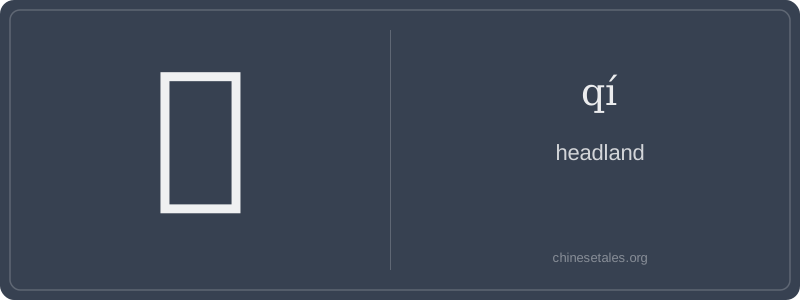
The earliest forms of 埼 appear in seal script (zhuānshū), where it was already clearly composed of two parts: the left-side radical 土 (tǔ, ‘earth/soil’) and the right-side phonetic component 己 (jǐ, ‘self’). Though no oracle bone version survives, bronze inscriptions show a simplified earth mound beside a stylized ‘self’ glyph — not depicting a person, but likely serving as a phonetic anchor. Over centuries, the 土 radical became standardized with three horizontal strokes and a downward hook, while 己 evolved from a looped, closed shape into today’s compact, square-topped form with a descending stroke — all 11 strokes now carefully balanced to suggest solidity and projection.
This character first appeared in authoritative dictionaries like the Shuōwén Jiězì (121 CE), defined as ‘a high bank projecting into water’ — confirming its ancient focus on topography over metaphor. Unlike many characters that drifted into abstract meanings, 埼 stayed remarkably faithful to its geomorphic roots: Tang poets used it to describe coastal watchtowers perched on headlands; Ming-era maps labeled capes with it precisely. Its visual structure reinforces meaning: 土 grounds it in earth; 己 (pronounced jǐ, but here borrowing sound for qí) provides the pronunciation while its closed, upright shape subtly echoes the verticality of a cliff face rising from the sea.
埼 (qí) is a beautifully precise geographical term — not just any piece of land, but specifically a rocky headland or promontory jutting boldly into water. Think of Cape Cod or the white cliffs of Dover: elevated, exposed, and geologically stubborn. It’s a literary, slightly archaic word — you’ll rarely hear it in casual speech, but it appears with quiet authority in poetry, place names, and historical geography texts. Its core feeling is one of natural grandeur and isolation: land asserting itself against the sea.
Grammatically, 埼 functions almost exclusively as a noun, often in compound words (like 埼岸 or 埼角), and rarely stands alone in modern usage. You won’t say *‘this is a 埼’* in daily conversation — instead, it anchors descriptive phrases: ‘the eastern 埼’, ‘a wind-scoured 埼’. Unlike common nouns like 岛 (dǎo, ‘island’) or 岸 (àn, ‘shore’), 埼 implies elevation, projection, and geological hardness — soft sandy spits don’t qualify. Learners sometimes misread it as qǐ (confusing tone) or miswrite its right side as 巳 (sì) instead of 己 (jǐ), which changes both sound and meaning entirely.
Culturally, 埼 carries subtle poetic weight: in classical Chinese, headlands symbolize steadfastness, solitude, or vantage points for reflection — think of Du Fu gazing from a cliff at turbulent rivers. It’s also embedded in real Japanese place names (e.g., Saitama Prefecture’s former name ‘Musashi no Kuni’ included 埼玉 — ‘Kuri’ + ‘tama’, where 埼 meant ‘headland’), showing how this character crossed linguistic borders while retaining its geomorphic essence. Mistake it for 崎 (qí, also ‘promontory’) and you’re close — but 崎 is more common in Japanese, while 埼 is the native Chinese form, rarer and more evocative.