埸
Character Story & Explanation
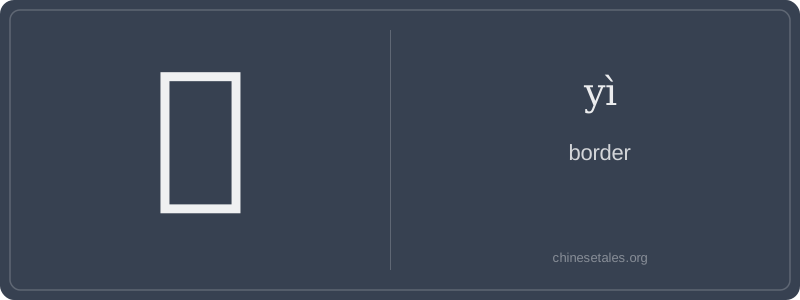
The earliest form of 埸 appears in Warring States bamboo slips as a simple yet vivid pictograph: a horizontal line (representing the ground) with two short vertical strokes jutting upward — like fence posts marking a limit — all sitting atop the 土 element. Over centuries, the 'posts' evolved into the right-side component 易 (yì), which originally looked more like two crossed lines (symbolizing exchange or demarcation), while the left side solidified as 土. By the Han dynasty seal script, the structure stabilized: 土 + 易 — earth marked by a sign of change or division. The eleven strokes we write today preserve that ancient logic: soil + clear, deliberate distinction.
This visual logic shaped its meaning: 埸 never meant 'border' in the abstract sense, but specifically the *marked* edge of cultivated land — the furrow separating one family’s rice paddy from the next. The Shuōwén Jiězì (121 CE) defines it as 'the boundary of fields', and it appears in Tang-dynasty tax records listing '田埿亩数' (acres defined by field boundaries). Even today, in southern Fujian dialects, elders use 埸 when recounting how their grandfather moved a stone marker during drought — not to steal land, but to redraw fate in dirt.
Think of 埸 (yì) not as a dry dictionary definition like 'border', but as the quiet, earthy line where one field ends and another begins — a boundary drawn in soil, not ink. It carries the grounded, tangible weight of the 土 (tǔ, 'earth') radical, telling you instantly this is about physical, territorial limits: farmland edges, village perimeters, or ancestral land markers. Unlike abstract terms like 界 (jiè) or 边 (biān), 埸 feels agricultural, intimate, and slightly archaic — it’s the kind of word you’d find carved on a stone marker in a Jiangsu countryside village, not in a modern news headline.
Grammatically, 埸 is almost always a noun and rarely stands alone; it appears in compounds like 田埿 (tián yì, 'field boundary') or in poetic or literary contexts describing territorial integrity. You won’t hear it in daily speech — no one says 'my apartment’s 埸' — and it’s never used as a verb or adjective. A common learner mistake is overgeneralizing it to mean any kind of border (e.g., national borders), but that’s strictly 界 or 边. 埸 is humble, local, and rooted — literally.
Culturally, 埸 reflects China’s agrarian soul: land wasn’t just property, but identity, lineage, and cosmic order. In classical texts, disputes over 埸 could spark lawsuits or clan feuds — because moving a boundary stone wasn’t theft of dirt, but erasure of memory. Modern learners often skip it since it’s HSK-free, but mastering 埸 unlocks richer reading in regional literature, local histories, and even old legal inscriptions — where every inch of earth had a name, and that name was often 埸.