埶
Character Story & Explanation
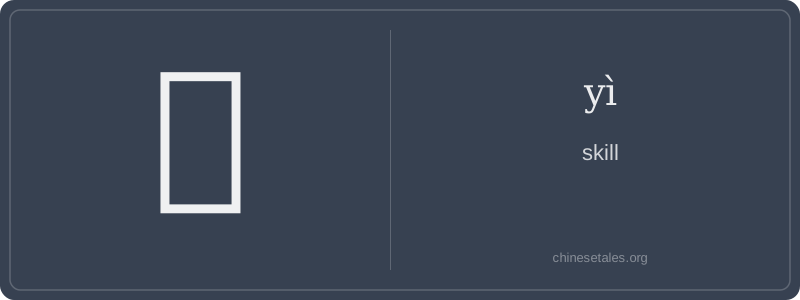
Trace 埶 back to Shang dynasty oracle bones (c. 1200 BCE), and you’ll see a vivid pictograph: a kneeling figure (the top part, resembling 丮) carefully planting or tending a seedling in rich soil (the bottom 土). The arms are bent, hands cupped — not passive observation, but *intentional, skilled cultivation*. Over centuries, the kneeling figure simplified into the top component 丮 (jǐ, an archaic character meaning ‘to hold with both hands’), while the soil base solidified into the standard 土 radical. By the seal script era, the shape had stabilized into today’s 11-stroke form — still unmistakably ‘hands working earth’.
This origin directly shaped its meaning: 埶 meant ‘to plant’ or ‘to cultivate’ in early texts like the *Shuō Wén Jiě Zì* (121 CE), but quickly extended to ‘to nurture skill’ — because just as seeds require attentive care to flourish, so too does human ability. By the Warring States period, philosophers used 埶 to describe the disciplined training behind moral virtue and artistic excellence. Though it later fell out of daily use (replaced by 藝 for ‘art’), its semantic DNA survives: every time you see 藝術 or 技藝, you’re seeing 埶’s legacy — the idea that true artistry grows from the ground up, not from thin air.
Don’t let the archaic look of 埶 fool you — it’s not just ‘skill’ in the abstract sense, but specifically *cultivated, embodied skill*, like a master calligrapher’s hand or a potter’s intuitive control over clay. It carries the quiet weight of practice made physical: not just knowing how, but *being able to do it without thinking*. That’s why it rarely stands alone today — you’ll almost never hear someone say ‘wǒ yǒu yì’ (I have skill) with this character; it lives inside compound words, where its nuance deepens the meaning.
Grammatically, 埶 appears exclusively in formal, literary, or classical-derived compounds — think academic writing, historical texts, or refined artistic critique. You won’t find it on subway signs or WeChat memes. Its presence signals elevated register: for instance, 技藝 (jì yì, ‘craftsmanship’) implies both technical precision and aesthetic judgment, while 藝術 (yì shù, ‘art’) literally means ‘skill + technique’, revealing how Chinese traditionally grounds art in disciplined practice, not just inspiration. Learners often mistakenly substitute it for 易 (yì, ‘easy’) or 義 (yì, ‘righteousness’) — sounds alike, worlds apart.
Culturally, 埶 is a time capsule: it preserves the ancient Confucian ideal that true mastery arises from sustained, grounded effort — notice the 土 (tǔ, ‘earth/soil’) radical at the bottom? That’s no accident. Just as roots anchor a tree, real skill must be rooted in patient, tangible practice. Modern learners sometimes overestimate its frequency — it’s absent from HSK because contemporary Mandarin uses simpler synonyms like 技能 (jì néng) or 手艺 (shǒu yì). But when you *do* encounter 埶 — in a museum caption, a calligraphy essay, or an old poem — it’s a whisper from China’s scholarly past, reminding you that skill isn’t downloaded; it’s grown.