埵
Character Story & Explanation
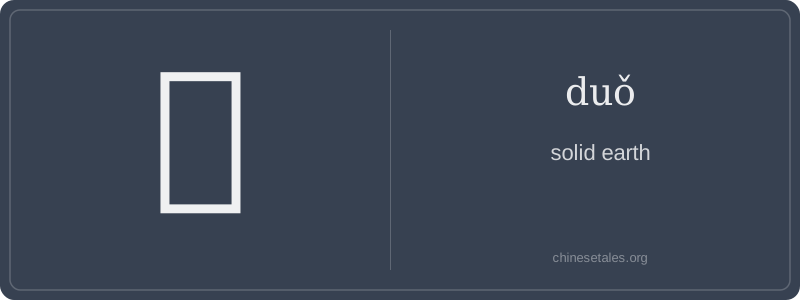
The earliest form of 埵 appears in late Warring States bronze inscriptions as a compound pictograph: a simplified 土 (earth) radical stacked beneath a stylized representation of piled, compressed layers — originally drawn as three horizontal strokes with slight downward bulges, suggesting mass pressing down. Over centuries, those bulging lines hardened into the three distinct, slightly slanted strokes of the upper component (冎), while the lower 土 remained anchor-like, its two short horizontal strokes and vertical line grounding the whole. By the Han dynasty clerical script, the upper part had stabilized into its modern shape — no longer a pictorial pile, but a graphic symbol of density made abstract.
This visual compression directly shaped its meaning: not just 'earth', but 'earth that refuses to shift'. In the Guoyu (Discourses of the States), 埵 appears in a passage describing ritual earth mounds built for ancestral rites — 'their bases were 埵, unshaken by wind or flood'. The character never entered daily vocabulary, but persisted in literary registers precisely because of this semantic precision: it names the quality of earth-as-archetype, not earth-as-material. Its rarity today isn’t decline — it’s conservation, like a fossil embedded in language’s bedrock.
At first glance, 埵 (duǒ) feels like a quiet, earthy character — literally 'solid earth' — but don’t let its calm surface fool you. It’s not about dirt or soil in the everyday sense; it evokes dense, unmoving, foundational earth — the kind that anchors mountains and resists erosion. Think less 'garden soil' and more 'bedrock'. This isn’t a word you’ll hear in casual conversation (it’s absent from HSK and even most modern dictionaries), but it appears with poetic weight in classical texts and literary compounds where gravity, stability, or immovability is at stake.
Grammatically, 埵 functions almost exclusively as a noun or attributive noun — never as a verb or standalone adjective. You won’t say 'the ground is 埵', but you might say '埞土' (duǒ tǔ) to mean 'unyielding, compacted earth'. Learners often mistakenly treat it like 土 (tǔ, 'earth/soil') or try to use it as a generic synonym — a trap that sounds archaic or outright wrong to native ears. It’s also frequently misread as duǒ (like 朵, 'flower') — same pinyin, totally different world.
Culturally, 埵 carries an almost geological solemnity. In pre-Qin ritual texts, it subtly reinforced cosmological ideas: earth wasn’t just passive matter — it was *dense intention*, the yin counterweight to heaven’s yang movement. Modern usage is rare but potent: when writers reach for 埵, they’re not describing terrain — they’re invoking endurance, silence, or ancient stillness. Confusing it with common earth-related characters (like 地 or 土) risks flattening that layered resonance into bland literalism.