埴
Character Story & Explanation
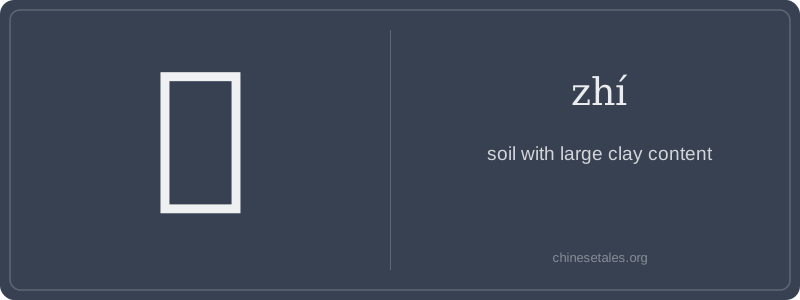
The earliest form of 埴 appears in bronze inscriptions (c. 1000 BCE) as a combination of 土 (a simple mound or plot of earth) and a vertical line with horizontal strokes — a stylized version of 直, which itself evolved from a pictograph of an eye above a ‘ten’-shaped base, symbolizing ‘upright vision’ or ‘unbroken line.’ Over centuries, the left side solidified into the standard 土 radical (three dots + horizontal stroke), while the right side streamlined into today’s 直: a vertical stroke (丨) crowned by a dot (丶), then three horizontals (一 一 一) — all 11 strokes locking together like clay particles under pressure.
This visual compactness mirrors its meaning: the character’s structure feels dense, grounded, and unbroken — much like the impermeable clay strata it names. In the *Classic of Poetry* (Shījīng), related terms appear in odes describing fertile riverbanks where ‘thick, cohesive earth’ (implied by 埴-like compounds) enabled stable foundations for ancestral altars. By the Han dynasty, 埴 was codified in agricultural manuals as the ideal subsoil layer beneath topsoil — invisible but vital, just like the character itself: rarely seen, yet structurally indispensable.
Think of 埴 (zhí) as the geologist’s whisper in Chinese — not just ‘soil,’ but specifically dense, sticky, clay-rich earth that clings to your boots and holds water like a stubborn memory. Its radical 土 (tǔ, ‘earth’) anchors it firmly in the realm of soil science, while the right-hand component 直 (zhí, ‘straight, direct’) isn’t describing posture — it’s a phonetic clue (they share the same pronunciation) *and* a subtle semantic nudge: clay soil is ‘direct’ in its density, unyielding, structurally uniform — no sandy gaps, no gravelly distractions. This isn’t poetic dirt; it’s technical terrain.
Grammatically, 埴 is almost never used alone. You’ll find it only in compound nouns or technical terms — like 埴土 (zhí tǔ, ‘clay soil’) or in classical or regional agricultural texts. Learners sometimes try to use it like 土 or 泥 (ní, ‘mud’), but that’s a dead end: no native speaker says *‘wǒ men zài wán zhí’* (‘we’re playing with clay soil’). It’s a lexical fossil — precise, rare, and reserved for contexts where soil composition matters: soil surveys, ceramic material sourcing, or historical land records.
Culturally, 埴 carries quiet prestige in traditional craft circles: ancient kilns in Jingdezhen prized specific 埴 layers for porcelain bodies because their fine, homogeneous particles yielded translucency and strength. Modern learners often misread the 直 component as ‘straight soil’ — a charming but misleading image — when really, it’s about molecular straightness: tightly packed, aligned clay platelets. Confusing it with common soil words like 地 (dì, ‘ground’) or 壤 (rǎng, ‘loam’) leads to unnatural phrasing — this character doesn’t describe where you stand; it describes *what the ground is made of*, down to the micrometer.