埭
Character Story & Explanation
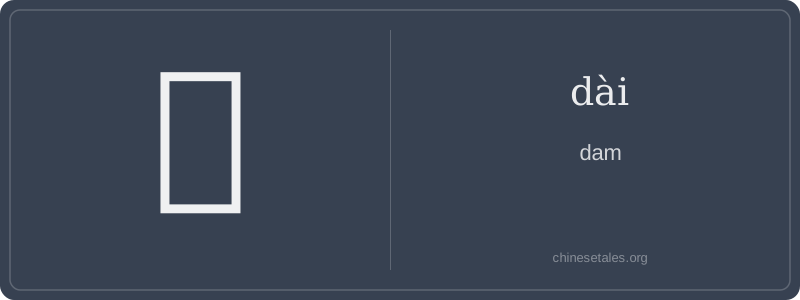
The earliest form of 埭 appears in Han dynasty clerical script, not oracle bones — because it’s a relatively late semantic compound. Its left side 土 (tǔ, 'earth') is unmistakable; the right side 大 (dà, 'big') originally wasn’t just 'big' — in this context, it’s a phonetic loan (shēngfú) hinting at pronunciation, but also subtly evoking scale: a large earthen structure. Over time, the stroke order solidified — starting with the horizontal stroke of 土, then the vertical, dot, and crossbar, followed by the three strokes of 大 — totaling eleven clean, grounded strokes that visually echo a low, wide berm rising from flat land.
By the Six Dynasties period (3rd–6th c. CE), 埭 was already entrenched in regional hydrology. The Records of the Three Kingdoms mentions ‘Qīngtáng dà’ (Qingtan Dam), and Li Daoyuan’s Commentary on the Water Classic describes how locals used 埭 to divert freshwater away from saltwater intrusion in the lower Yangtze. Its visual simplicity — earth + big — belies its functional precision: not a towering wall like a 坝, but a broad, permeable ridge, built by generations who knew that controlling water meant working *with* its weight, not against it.
At first glance, 埭 (dài) feels like a quiet, unassuming character — just 'dam' or 'dyke', a humble earthwork holding back water. But don’t underestimate it: in southern China, especially Jiangsu and Zhejiang, 埭 isn’t just infrastructure — it’s geography with memory. Many towns and villages bear names ending in 埭 (e.g., 乌埭, 白马埭), preserving centuries-old hydrological history. Unlike generic terms like 坝 (bà) or 堤 (dī), 埭 specifically implies a low, earthen barrier across a waterway — often built to control tidal flow or create irrigation channels in flat, watery landscapes.
Grammatically, 埭 is almost never used alone in modern speech; it appears almost exclusively in proper nouns (place names) or classical/literary compounds. You won’t say *‘I built a 埭’* — instead, you’ll read it on a village sign or in historical texts like the Book of Song, where it describes ancient water management in the Wu region. Learners sometimes misread it as dài (like 待) and assume it’s a verb — but 埭 is purely nominal, always concrete and topographic.
Culturally, 埭 reveals how Chinese language encodes environmental adaptation: every 埭 was a negotiation between human labor and riverine rhythm. It’s a relic-word — still alive on maps and in local dialects, yet nearly extinct in daily conversation. Mistaking it for similar-sounding characters (like 太 or 代) is common, but its true home isn’t in grammar drills — it’s in the damp soil of the Yangtze Delta, whispering about silt, seasons, and silent engineering.