埫
Character Story & Explanation
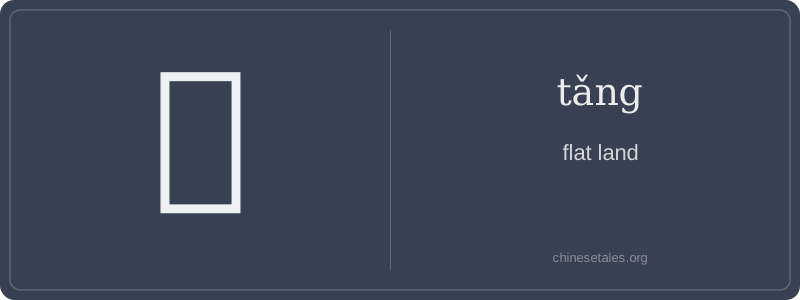
The earliest form of 埫 appears in Warring States bamboo slips (c. 475–221 BCE), not oracle bones — and it’s a brilliant piece of minimalist cartography. The left side, 土 (tǔ, 'earth'), anchors the character literally and semantically, while the right side, 尚 (shàng), originally depicted a raised platform or elevated altar in bronze inscriptions. But here, 尚 underwent radical simplification: its upper part (⺌) flattened, and its lower strokes converged into two parallel horizontal lines — visually echoing the very flatness it describes. Over centuries, clerical script smoothed the curves, and regular script standardized the clean, balanced structure we see today: earth + visual echo of horizontality.
This evolution reflects a semantic pivot: 尚 didn’t retain its original 'high' meaning; instead, its simplified shape became iconic of *uniform elevation* — not height, but *lack of variation*. By the Han dynasty, 埫 was used in texts like the *Shuǐ Jīng Zhù* (Commentary on the Waterways Classic) to name flat stretches along rivers where silt settled. Its visual duality — earth paired with a glyph that *looks* like leveled ground — made it a rare case where form doesn’t illustrate meaning literally, but *abstractly embodies* it: flatness as geometric consistency, not just low relief.
Think of 埫 (tǎng) as China’s linguistic equivalent of a ‘flatline’ on a medical monitor — not a sign of danger, but a precise, quiet declaration of horizontal stillness. Unlike the more common 平 (píng, 'flat' or 'peaceful'), which carries philosophical weight (as in 平安, 'peace and safety'), 埫 is purely topographic: it denotes flat, open land — especially uncultivated, naturally level terrain like riverbanks, floodplains, or coastal plains. It’s a word you’ll encounter in regional toponyms and classical geography texts, not in daily conversation.
Grammatically, 埫 functions almost exclusively as a noun, rarely as an adjective — and never as a verb or measure word. You won’t say *tǎng de dì* ('flat land') using 埫 attributively; instead, it appears in compound nouns (e.g., 沙埫, shā tǎng, 'sandy flatland') or place names (like 马埫村, Mǎtǎng Cūn). Learners sometimes mistakenly substitute it for 平 or 坦 (tǎn, 'level/forthright'), but 埫 has zero connotation of moral uprightness or emotional calm — it’s strictly geographical and inert.
Culturally, 埫 carries subtle regional flavor: it appears most often in northwestern and central Chinese dialect literature and local gazetteers, evoking the broad loess plateaus and alluvial plains of Shaanxi and Henan. A classic learner trap? Confusing its pronunciation with 坦 (tǎn) — just one tone shift changes a geological term into a word meaning 'frank' or 'open'. Also, since it’s absent from HSK and modern textbooks, many learners remain unaware it even exists — yet it surfaces in historical novels, poetry, and official land surveys where precision matters.