埧
Character Story & Explanation
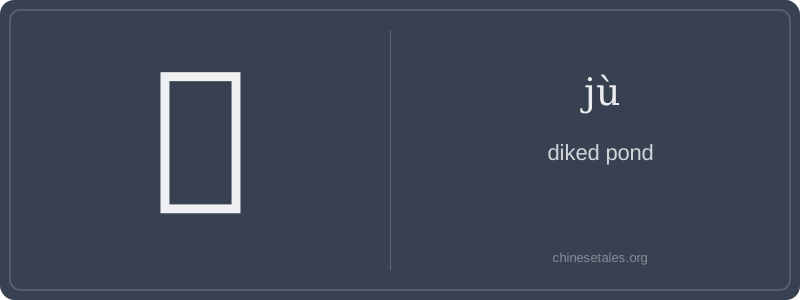
The earliest form of 埧 appears in Han dynasty seal script—not oracle bone, since it’s a later-coined character—but its structure is brilliantly transparent. It combines 土 (tǔ, ‘earth’, the radical on the left) with 具 (jù, ‘to have, to equip’, serving as both sound and semantic hint on the right). The ‘earth’ radical signals construction, grounding, and artificiality; the ‘具’ component doesn’t just provide pronunciation—it evokes preparedness, equipment, and readiness: a pond *equipped* with dikes. Visually, the modern form preserves this logic: the left side is unmistakably soil; the right retains 具’s distinctive upper ‘目’-like enclosure and lower ‘八+十’ base—evoking containment and structure.
Historically, 埧 emerged during the Warring States and early Han periods, when large-scale irrigation projects flourished. It appears in the Book of Han (《汉书》) describing flood-control works near the Huai River: ‘筑埧蓄水,以灌千顷’ (‘Build diked ponds to store water and irrigate a thousand qǐng’). Unlike natural lakes, 埧 was always purpose-built—often by conscripted labor—and thus carried connotations of collective effort and agrarian stewardship. Its visual composition—earth + preparedness—hasn’t wavered in over two millennia, making it a rare, stable glyph that literally holds water—and history.
Here’s the thing about 埧 (jù): it’s not just any pond—it’s a *human-made* one, carefully bordered by dikes or earthen embankments. Think rice paddies in terraced hillsides, or ancient irrigation reservoirs built to hold water for drought seasons. The character carries a quiet sense of intention and labor: water tamed, land shaped, nature guided—not conquered, but coaxed. You won’t hear it in daily chat; it’s literary, regional, and often appears in historical texts, local gazetteers, or ecological studies of traditional water management.
Grammatically, 埧 functions almost exclusively as a noun—never a verb or adjective—and almost never stands alone. It appears inside compound nouns (like 水埧 or 鱼埧) or in descriptive phrases with classifiers (e.g., 一座埧). Learners sometimes mistakenly treat it like 池 (chí, ‘pond’) or 湖 (hú, ‘lake’), but 埧 implies engineering: no dike = no 埧. Also, it’s tone-sensitive—jù (fourth tone), not jū or jǔ—so mispronouncing it risks sounding like ‘to gather’ (聚) or ‘to squat’ (踞), both homophones with very different vibes.
Culturally, 埧 reflects China’s millennia-old hydraulic civilization—where water control meant survival. In Fujian and Zhejiang, old village records refer to 埧 as communal assets managed by lineage elders. Modern learners rarely encounter it outside academic or heritage contexts, which is why it’s absent from HSK: it’s precise, poetic, and proudly niche. Mistake it for a generic ‘pond’, and you’ll miss the quiet dignity of human ingenuity baked into its strokes.