埤
Character Story & Explanation
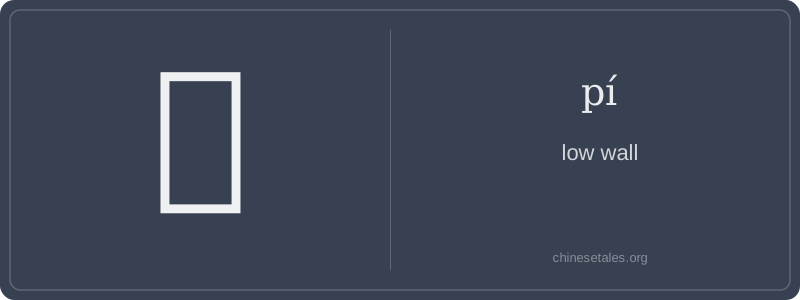
The earliest form of 埤 appears in seal script (not oracle bone, as it’s relatively late), where it clearly combines 土 (earth/soil) on the left and 卑 (bēi, 'low/humble') on the right. 卑 itself was originally a pictograph of a servant kneeling — conveying subordination and low height — and its inclusion here is brilliantly literal: 'earth + low = low wall made of earth'. Over time, the right-hand component simplified from the full 卑 (11 strokes) to its modern cursive-influenced shape, while the left 土 retained its three-stroke form. Crucially, every stroke serves purpose: the horizontal line at the top of 卑 suggests a flat crest; the two short verticals beneath echo upright supports — all reinforcing the idea of a restrained, human-scaled barrier.
This character emerged during the Warring States and Han periods, when large-scale water conservancy projects flourished. The Book of Han mentions 埤 in records of local granaries and irrigation networks: '凡陂塘皆以土为埤,蓄水溉田' ('All ponds and reservoirs use earth-walls — 埤 — to store water for fields'). Its visual logic never wavered: even today, seeing the character evokes compacted soil rising just high enough to hold back a shallow flow — not to block, but to guide. That humble, practical intelligence is baked into its strokes.
Think of 埼 (pí) not as a flashy character, but as a quiet, functional one — like a sturdy garden border or a low earthen berm holding back water. Its core meaning is 'low wall' or 'embankment', specifically one built from earth (hence the 土 radical), often for irrigation or flood control. It’s not abstract — it’s tactile, grounded, and deeply agricultural. You won’t hear it in daily chat ('I’m tired' or 'What’s for dinner?'), but you *will* spot it in regional place names (like Taiwan’s Guishan Pí), historical texts on water management, or technical documents about rural infrastructure.
Grammatically, 埤 is almost always a noun — never a verb or adjective — and rarely stands alone. It appears in compounds (e.g., 水埤, 魚埤) or in fixed geographical terms. Learners sometimes misread it as pī (like 皮) due to the similar sound, or confuse it with 坡 (pō, 'slope') because both relate to landforms — but 坡 implies incline, while 埤 implies containment. Also, don’t expect verbs like 'to build a 埤'; instead, you’d say 修埤 (xiū pí, 'repair an embankment') — it’s always modified by action verbs.
Culturally, 埤 reflects ancient China’s hydraulic wisdom: before concrete dams, farmers shaped the earth itself into gentle, functional walls. In southern Fujian and Taiwan, where centuries-old irrigation systems still operate, 埤 carries quiet reverence — it’s infrastructure with memory. A common mistake? Assuming it means 'dam' (which is usually 坝 bà). But 埤 is humbler: lower, older, earthier — more 'garden wall' than 'Great Wall'. It’s a reminder that Chinese characters encode not just words, but agrarian philosophy.