垭
Character Story & Explanation
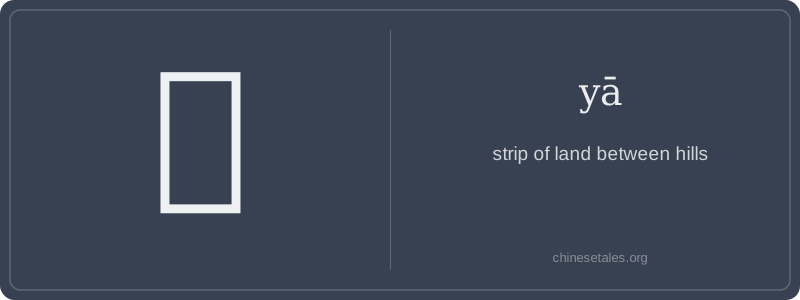
The earliest form of 垭 isn’t found in oracle bones — it’s a later creation, emerging around the Han dynasty as a semantic-phonetic compound. Its left side, 土 (tǔ, ‘earth/soil’), is the radical — unmistakably grounding the character in landforms. The right side, 亚 (yà), originally depicted a ritual vessel with symmetrical arms (like a cross with flared ends), later came to mean ‘second’ or ‘subordinate’ — but here, it serves phonetically: both 亚 and 垭 share the ‘ya’ sound (though tones diverged). Visually, the nine-stroke structure balances earth (3 strokes) and symmetry (6 strokes), mirroring the bilateral hill formation it describes.
By the Tang and Song dynasties, 垭 appeared in local gazetteers describing mountainous frontier regions. In classical poetry and travelogues, it evokes quiet transition — not danger like a precipice (崖 yá), nor grandeur like a peak (峰 fēng), but the humble, functional seam between heights. Its shape — earth cradled by the balanced, slightly descending lines of 亚 — subtly echoes the landform: two rising slopes meeting at a lowered center. This visual logic made it indispensable for naming passes where roads, footpaths, or even wind patterns converged — places that were neither up nor down, but *between*.
Think of 垭 (yā) as Chinese geography’s quiet specialist — it doesn’t mean ‘mountain’ or ‘valley’ in the general sense, but something far more precise: a narrow, often pass-like strip of land *between* two hills or ridges. It’s not a broad valley (谷 gǔ) or a deep gorge (峡 xiá), but a subtle, saddle-shaped landform where terrain dips just enough to allow passage — like nature’s own gentle doorway. Native speakers use it almost exclusively in place names and topographic descriptions, especially in Southwest China (Sichuan, Yunnan, Guizhou), where such features are abundant and culturally significant for trade, migration, and even folklore.
Grammatically, 垭 is nearly always a noun — rarely used alone, almost never as a verb or adjective. You’ll see it in compound nouns (e.g., 山垭 shān yā, ‘hill pass’) or embedded in proper nouns like village names (e.g., 铁山垭 Tiěshān Yā). Learners sometimes mistakenly treat it like a generic ‘gap’ or ‘opening’, but it carries strong geomorphological specificity: if there aren’t two adjacent elevated landforms framing it, it’s not a 垭. Also, it’s almost never used metaphorically — unlike ‘gap’ in English, you wouldn’t say ‘a gap in communication’ using 垭.
Culturally, 垭 reflects how deeply Chinese toponymy encodes landscape perception: every hill, ridge, and saddle has its own lexical ‘fingerprint’. A common learner pitfall is misreading it as ‘ya’ meaning ‘to press’ (压 yā) — same pinyin, totally unrelated meaning and radical. And because it’s absent from HSK and most textbooks, learners often miss it entirely until they hike through rural Sichuan or read local literature — where suddenly, 垭 appears again and again, quietly anchoring place identity in terrain.