埠
Character Story & Explanation
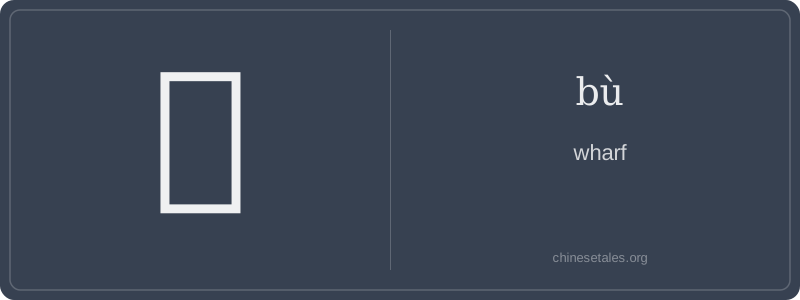
The earliest form of 埠 appears in seal script (c. 3rd century BCE), built from 土 (tǔ, 'earth/soil') on the left and 阜 (fù, an archaic variant meaning 'mound' or 'raised ground') on the right — not the modern 又. 阜 itself was originally a pictograph of a stepped hillside, later stylized into the top part of 埠. Over centuries, 阜 simplified to 又 (yòu) — a phonetic component — while 土 remained the semantic anchor. The 11 strokes reflect this fusion: four for 土, seven for the right side (一、丿、丨、丿、丶、丶、丶), visually grounding the character in earthbound infrastructure.
This evolution mirrors its meaning shift: from 'raised earthen landing place' (a natural riverbank embankment) to 'officially designated trading port'. By the Ming and Qing dynasties, 埠 appeared in administrative documents listing 'treaty ports' — places like 汕頭埠 or 青島埠, where customs offices stood and foreign consulates sprang up. Classical usage is rare, but the character thrives in late imperial gazetteers and Republican-era newspapers, always tied to commerce, geography, and state control of access — making it less a simple 'wharf' and more a 'sovereign threshold'.
Think of 埠 (bù) as China’s historical 'port of entry' — not just a physical wharf, but a bustling, slightly gritty gateway where merchants, dialects, and foreign goods first hit land. Unlike the neutral, modern term 码头 (mǎtou), 埠 carries old-world texture: it evokes 19th-century treaty ports like Shanghai or Guangzhou, where steamships docked, compradors negotiated, and Cantonese-English pidgin was born. It’s not used for everyday piers — you won’t see it on a Beijing park sign — but in names, history texts, or regional speech.
Grammatically, 埠 almost never stands alone. It’s a bound morpheme — like English ‘-dock’ or ‘-harbor’ — appearing only in compounds (e.g., 商埠 shāngbù 'commercial port') or proper nouns (汕頭埠 Shàntóu bù). Learners sometimes wrongly treat it as a verb ('to dock') or try to use it as a generic noun for 'wharf' — but that’s a classic fossil-word trap: 埠 is lexicalized, not productive. You’d say 我在碼頭等你, never *我在埠等你.
Culturally, 埠 hints at China’s layered relationship with foreign trade — often with subtle connotations of openness *and* vulnerability. In literature, it appears in Lin Yutang’s essays or Lao She’s descriptions of Tianjin’s waterfront, always weighted with social nuance. A common mistake? Confusing it with 布 (bù, 'cloth') — same sound, totally different world. Remember: if there’s dirt (土) under your feet and ships overhead, it’s 埠 — not fabric.