埗
Character Story & Explanation
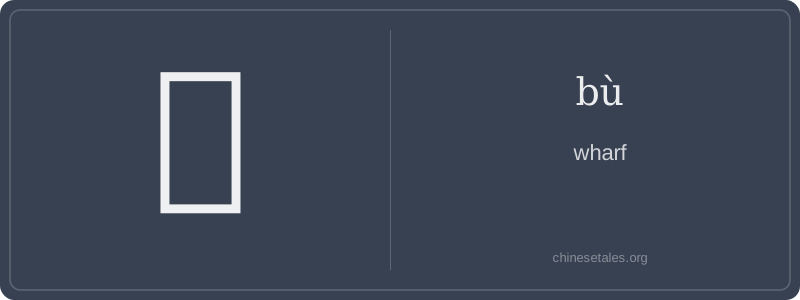
The earliest form of 埗 appears in Han dynasty clerical script (lìshū), not oracle bones — it’s too late for that era. Visually, it began as a clear compound: 土 on the left, and a simplified form of 代 (itself derived from a pictograph of a person holding a weapon, later abstracted) on the right. In seal script, the right side had three horizontal strokes and a downward hook — echoing 代’s structure but already stylized. Over centuries, the top stroke of 代 flattened, the middle became a dot, and the bottom evolved into the current + 丶 shape — all while the earth radical remained solid and grounded, anchoring the meaning.
Meaning-wise, 埗 emerged in the Warring States and Han periods alongside massive water-control projects in the Yangtze Delta. Unlike 码头 (a constructed pier), 埗 implied an *earthwork*: a deliberately raised bank to hold back water or shelter boats. The Tang poet Bai Juyi referenced similar structures in poems about canal maintenance, calling them ‘silent guardians of the fields.’ Its visual logic is elegant: earth (土) doing work (代’s original sense of ‘acting on behalf of’) — i.e., earth *substituting* for walls or stone, holding back water where humans couldn’t build higher. That conceptual blend — earth as active agent — still echoes in every use of the character today.
埭 (bù) is a quiet, poetic word for 'wharf' or 'embankment' — not the bustling modern dock you’d see in Shanghai, but a low, earthen barrier built along rivers or canals to control water flow or create safe mooring spots. It’s deeply rooted in hydraulic engineering and rural life: think mud-brick levees beside rice paddies or stone-faced jetties on quiet tributaries. The character itself is a semantic-phonetic compound: the left radical 土 (tǔ, 'earth') tells you it’s land-related, while the right component 代 (dài, 'to replace') gives the sound — though note: it’s pronounced bù, not dài! This irregular reading is a classic 'phonetic loan' quirk: ancient scribes borrowed the shape of 代 because its Old Chinese pronunciation *lˤats was close enough to *pˤrak (the ancestor of bù), and the sound drifted over millennia.
Grammatically, 埗 is almost always a noun and appears in place names or technical/historical contexts — never in everyday speech like 码头 (mǎtóu, 'dock'). You’ll find it in terms like 沙埭 (shā bù, 'sandy embankment') or in old village names (e.g., 东埭村 Dōngbù Cūn, 'East Embankment Village'). Learners rarely use it actively, but misreading it as dài (confusing it with 代) is a frequent slip — especially since the right side looks identical. Remember: if you say 'dài' here, native speakers won’t recognize the word at all.
Culturally, 埗 evokes Jiangnan’s watery landscape — the crisscrossed canals of Suzhou and Ningbo where generations built earthen weirs to manage tides and irrigation. It’s a character that breathes quiet history: no imperial decrees mention it, but local gazetteers from the Ming dynasty describe 'repairing the 埗 after spring floods.' Its absence from HSK reflects how specialized vocabulary slips through standardized curricula — yet knowing it unlocks real-world maps, historical texts, and the layered geography of southern China.