埕
Character Story & Explanation
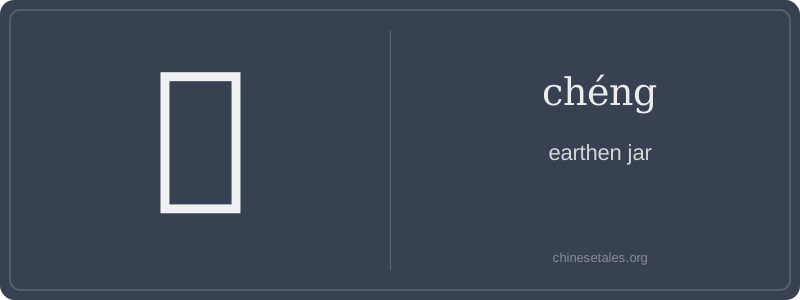
The earliest form of 埕 appears in Han dynasty clerical script (lìshū), not oracle bone — it’s relatively late-born! Its structure is transparent: left side 土 (earth) + right side 成 (chéng, 'to complete, become'). Visually, it began as 土 beside a simplified 成 — originally depicting a ritual vessel being 'completed' or 'formed' through firing. Over centuries, the right-hand 成 stabilized into its modern shape: 戊 (wù, weapon/earthly branch) atop 丁 (dīng, nail/strength), symbolizing the labor and craft needed to transform raw clay into a durable vessel. The 10 strokes emerged precisely from this fusion: 土 (3 strokes) + 成 (7 strokes) = 10 — no stroke is decorative; each marks a step in making earth *become* container.
This 'earth-made-complete' logic shaped its meaning: not just any jar, but one *finished by fire and function*. In Ming-Qing vernacular literature, 埕 appears in farming manuals and household inventories — always linked to preservation: 'a three-year soy sauce 埕', 'the ancestral rice wine 埏'. Interestingly, its visual rhythm mirrors its use: the solid, low-set 土 grounds the character, while 成 rises slightly — like a jar’s wide base supporting its rounded, finished rim. Even today, when artisans shape a 埕 on the wheel, they speak of 'letting the clay 成' — echoing the character’s ancient promise: earth, given time and fire, becomes vessel.
Think of 埕 (chéng) as the humble, earthy cousin of more glamorous vessels like 瓶 (bottle) or 缸 (large crock) — it’s specifically an earthen jar: thick-walled, unglazed, fired at low temperatures, and deeply tied to rural life, fermentation, and storage. The character radiates groundedness — literally, since its radical is 土 (tǔ, 'earth/soil'), which occupies the left side and tells you immediately this object is made from clay dug from the ground. It’s not a poetic or abstract term; it’s functional, tactile, and regionally evocative — especially in southern China and Taiwan, where you’ll still see 埕 used for pickling jars, rice wine containers, or even small fish ponds (a semantic extension from 'container' to 'shallow, earthen basin').
Grammatically, 埕 is almost always a noun and rarely stands alone — it appears in compounds (like 酱埕 or 米酒埕) or with classifiers like 口 (kǒu) or 只 (zhī). Learners often mistakenly treat it like a generic 'jar' and try to use it with verbs like 'buy' or 'break' without context — but native speakers rarely say *'I broke a chéng'* out of nowhere; it’s always embedded in a concrete, culturally loaded scene: the smell of soy sauce fermenting, the weight of a lid lifted at harvest time. It’s also tone-sensitive: confusing chéng with chēng (to prop up) or chěng (to show off) will land you in very awkward territory!
Culturally, 埕 quietly anchors traditions that modern life erodes — think home-brewed 米酒 (mǐjiǔ, rice wine) aging in a cool, dark 埕 for months, or grandmother’s century-old pickle jar passed down like heirloom silver. Mistaking it for a porcelain vase or stainless-steel container misses its soul: it’s porous, imperfect, and alive with microbial culture. And crucially — it’s *not* used for modern kitchenware; using 埕 for a Tupperware box would sound hilariously anachronistic, like calling your smartphone a 'candlestick phone'.