埒
Character Story & Explanation
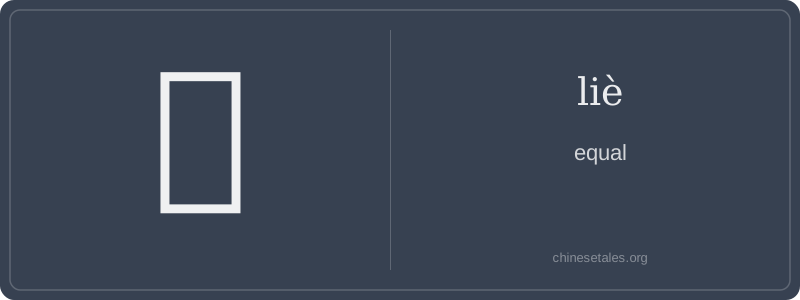
The earliest form of 埒 appears in bronze inscriptions of the Western Zhou (c. 1046–771 BCE) as a pictograph showing two parallel horizontal lines — representing leveled earth — flanked by two vertical strokes suggesting boundary markers or earthen walls. Over time, the top line became the radical 土 (tǔ, 'earth'), anchoring its meaning in terrain; the bottom evolved into 列 (liè), originally depicting 'arranged banners', but here repurposed phonetically (both share the liè sound) and semantically — 'ordered division'. By the Qin seal script, the character stabilized into its modern ten-stroke structure: 土 on top, 列 beneath, visually declaring 'earth defined by ordered limits'.
This visual logic shaped its meaning: 埒 didn’t just mean 'equal' — it meant 'equal *because* bounded and leveled'. In the Zuo Zhuan, it describes battlefields prepared so neither army held elevation advantage — 'a 埒 of readiness'. Later, in Tang poetry, it symbolized moral parity: two sages standing on the same ethical 埒. Even today, its shape whispers 'ground-level fairness': the 土 insists it’s physical, earthly balance; the 列 hints at deliberate, visible demarcation — not abstract equality, but equality you can stand on.
At first glance, 埒 (liè) feels like a quiet, old-fashioned word — it means 'equal' or 'on par', but not the everyday kind you’d use in 'We’re equal partners'. Instead, it’s a literary, almost poetic term of equivalence, often implying *balance achieved through boundary or containment*. Think less 'same rights' and more 'level ground where no side has advantage' — like two armies facing off across an even field. It carries weight: this isn’t casual sameness; it’s measured, structural parity.
Grammatically, 埒 rarely stands alone. You’ll almost always see it in compounds like 势均力敌 (shì jūn lì dí, 'forces evenly matched') or in set phrases like 不分轩轾 (bù fēn xuān zhì) — where 埒 appears in classical idioms meaning 'no distinction in rank or merit'. It’s also used postpositionally in formal writing: 伯仲之间,难分高下,更无轩轾之埒 (bó zhòng zhī jiān, nán fēn gāo xià, gèng wú xuān zhì zhī liè) — 'They’re like elder and younger brothers; their abilities are so close, there’s not even a ridge-line of distinction between them.' Note: never say '他和我埒' — that’s ungrammatical. 埒 doesn’t take subjects directly like 是 or 相等.
Culturally, 埒 is a relic of classical battlefield and ritual geography: it evokes the earthen embankments built to mark neutral zones or level ceremonial grounds. Learners often misread it as 'lie' (like lying down), or confuse it with common words like 列 (liè, 'row') — but 埒 is about *horizontal equilibrium*, not vertical listing. Its rarity today makes it a subtle marker of literary fluency: spotting it in a newspaper editorial or essay signals sophistication — and possibly a writer who’s read the Zuo Zhuan.