埏
Character Story & Explanation
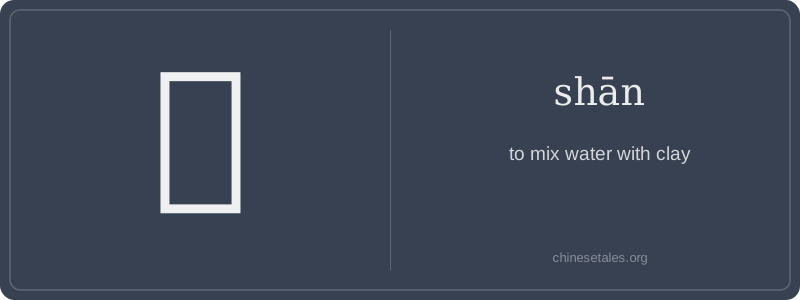
The earliest form of 埏 appears in seal script as a combination of 土 (earth/clay) on the left and 延 (yán, 'to extend, stretch') on the right — not as a phonetic loan, but as a semantic hint: the slow, deliberate stretching and folding motion needed when working wet clay. In bronze inscriptions, the right side resembled a hand pulling at pliant material; over centuries, 延 simplified into the modern 延 shape we see today — three horizontal strokes, a vertical, and a final hook — mirroring the rhythmic push-pull of kneading. The nine strokes encode both substance (土) and action (延): 3 for clay’s malleability, 6 for the cyclical motion of preparation.
This character first appeared in the *Huainanzi* (2nd c. BCE) describing how sages 'shān zhí wéi qì' (shape clay into vessels) — linking material craft with moral cultivation. Later, in Tang dynasty kiln manuals, 埏 denoted the critical moisture calibration step before wheel-throwing: too dry, and the vessel cracks; too wet, and it collapses. The visual duality — solid earth meeting fluid extension — became a metaphor in Neo-Confucian texts for harmonizing human nature (性) with acquired habits (习). Even today, master potters in Jingdezhen refer to 'shān ní' as the silent, sacred moment when earth becomes ready to hold form.
Think of 埏 (shān) as the ancient Chinese equivalent of 'kneading dough' — but for clay, not bread. It’s not about baking; it’s about preparation: the precise, tactile act of mixing water into raw earth to achieve just the right plasticity for pottery or bricks. Unlike common verbs like 和 (hé, 'to mix') or 拌 (bàn, 'to stir'), 埏 is hyper-specific — it’s a craft-term reserved for clay-and-water alchemy, evoking the quiet focus of a potter’s hands sinking into cool, yielding mud.
Grammatically, 埏 is almost always a transitive verb and appears in classical or technical contexts — never in casual speech or HSK materials. You’ll find it in historical texts describing kiln work ('埏泥制坯' — 'knead clay to form blanks') or modern archaeology reports ('埏埴为器' — 'shape and fire clay into vessels'). It rarely takes aspect markers like 了 or 过; instead, it often pairs with verbs like 制 (make), 烧 (fire), or 造 (fabricate) in compound structures. Learners mistakenly try to use it like 混 (hùn, 'to mix randomly') — but 埏 implies intention, skill, and material mastery, not haphazard blending.
Culturally, this character anchors us in China’s millennia-old ceramic tradition — from Neolithic Yangshao painted pottery to Tang sancai glazes. Its rarity today makes it a linguistic fossil: still legible, still precise, but spoken only by specialists or quoted by scholars. A common error? Misreading its 土 radical as generic 'earth' — when here, 土 is literally *wet clay*, not soil or land. Pronounced yán in rare literary compounds (e.g., 埏隧, 'tunnel entrance'), that reading is archaic and mostly obsolete — stick with shān unless you’re translating Han dynasty tomb inscriptions.