埌
Character Story & Explanation
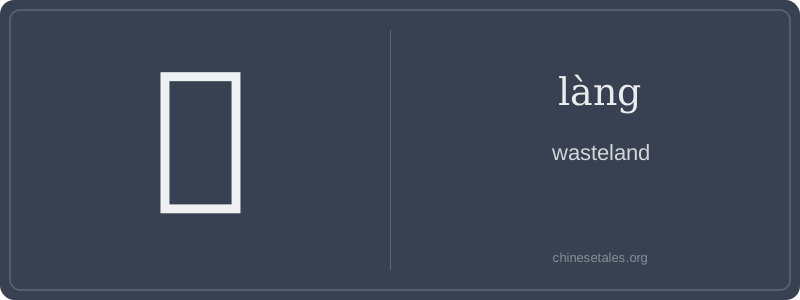
The earliest trace of 埌 appears not in oracle bones but in Han dynasty steles and Southern Song local scripts — a rare case of a character born from regional geography rather than ritual symbolism. Visually, it merges 土 (tǔ, ‘earth’, the radical at left) with 良 (liáng, ‘good’, on the right). But here’s the twist: 良 wasn’t chosen for meaning — its shape was borrowed purely for sound (làng ≈ liáng in Middle Chinese), making 埌 a phonosemantic compound where the ‘good’ part is actually a decoy. The left-hand 土 anchors it firmly in the earth realm, while the right-hand component evolved from a simplified form of 粮 (liáng, ‘grain’) — subtly implying land *devoid* of grain, hence wasteland.
This semantic irony deepened over centuries: in Tang dynasty poetry, 埌 appeared only in frontier verses describing abandoned military outposts; by the Qing, it anchored place names like ‘埌尾村’ (Làngwěi Cūn, ‘Wasteland’s End Village’) — real villages in Guangxi still bearing the name today. The character never entered standard lexicons like the Kangxi Dictionary as an independent entry, surviving instead through oral toponymy and regional writing traditions. Its visual quiet — no busy strokes, no radicals suggesting life or growth — mirrors its meaning: land that has stopped speaking to humans.
Think of 埌 (làng) as China’s linguistic equivalent of a ‘ghost town’ sign — not just empty land, but land that has been *abandoned by time itself*: wind-scoured, vegetation-starved, and culturally silent. Unlike the neutral ‘field’ (田 tián) or generic ‘land’ (地 dì), 埌 carries visceral desolation — it’s the kind of place where even crows hesitate to land. You’ll rarely see it in modern speech; it lives mostly in literary descriptions, regional toponyms (especially in Guangxi and Guangdong), and poetic lamentations about lost villages or forgotten borders.
Grammatically, 埌 functions almost exclusively as a noun — never as a verb or adjective — and almost never appears without modifiers: you won’t say ‘this is 埌’, but rather ‘a vast, barren 埌’ (广埌的埌) or ‘the ancient 埌 beyond the ridge’. It resists pluralization and doesn’t take aspect particles like 了 or 过. A classic learner trap? Assuming it’s interchangeable with 荒地 (huāngdì, ‘wasteland’) — but while 荒地 implies potential for reclamation, 埌 suggests irrevocable vacancy, like a geological scar.
Culturally, 埌 appears in Southern Chinese dialect literature and Ming-Qing local gazetteers describing frontier zones — often paired with words like ‘野’ (yě, ‘wild’) or ‘莽’ (mǎng, ‘jungle-thick wilderness’) to amplify its haunting emptiness. Its rarity means native speakers may misread it as ‘浪’ (làng, ‘wave’) or ‘郎’ (láng, ‘young man’) — so if you use it, you’re not just naming land; you’re invoking a very specific, almost mythic kind of silence.