埆
Character Story & Explanation
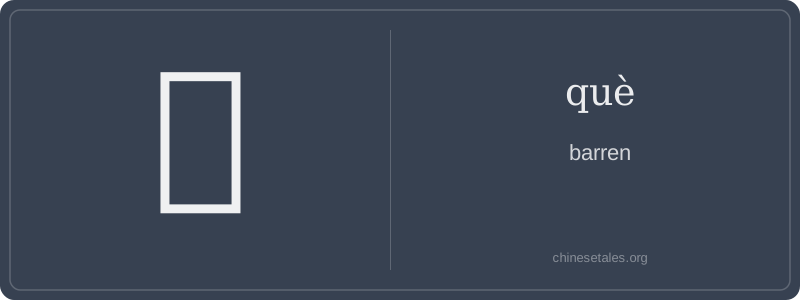
The earliest form of 埆 appears in bronze inscriptions as a compound pictograph: on the left, a simplified representation of ‘earth’ (土, tǔ), and on the right, a stylized depiction of a broken plowshare or fractured stone — not a person or plant, but something *shattered by the land itself*. Over centuries, the right-hand element evolved from a jagged line into the modern ‘角’-like component (though unrelated to 角 jiǎo), while the left ‘土’ remained stable. Crucially, this wasn’t a picture of *lack* (no plants), but of *resistance*: soil so hard and unyielding it breaks tools — a visceral, tactile origin.
This physical resistance shaped its semantic journey. In the *Shuōwén Jiězì* (c. 100 CE), Xu Shen defined 埆 as ‘soil that cannot be tilled’ — emphasizing agency, not deficiency. By the Ming dynasty, it appeared in local gazetteers describing northwest Gansu’s ‘què dì’ (barren land), always paired with ecological warnings: ‘When 埆 spreads, villages migrate.’ Its visual rigidity — sharp angles, no curves — mirrors its meaning: no softness, no yield, no compromise. Unlike synonyms, 埆 never acquired figurative extensions (e.g., ‘barren hope’); its meaning stayed stubbornly, beautifully literal.
At first glance, 埆 (què) feels like a linguistic ghost — it’s real, attested in dictionaries and classical texts, yet nearly extinct in modern speech. Its core meaning ‘barren’ isn’t just about infertile soil; it evokes a deep, almost poetic desolation — land so dry and lifeless it resists cultivation, memory, even metaphor. In classical usage, it carried a quiet moral weight: barrenness wasn’t neutral — it signaled imbalance, neglect, or cosmic disharmony, echoing Daoist and agricultural cosmologies where fertile earth mirrored virtuous governance.
Grammatically, 埆 is almost always an adjective modifying nouns like 地 (dì, land), 土 (tǔ, soil), or 田 (tián, field), and it rarely stands alone. You won’t hear ‘this land is 埆’ in casual conversation — instead, it appears in fixed compounds (e.g., 埆地) or literary descriptions. Learners often mistakenly treat it like common adjectives such as 贫瘠 (pínjí, ‘infertile’) or 荒 (huāng, ‘desolate’), but 埆 is far more archaic and stylistically heavy — using it in daily speech sounds like quoting a Tang dynasty farmer-poet at a café.
Culturally, 埆 reveals how Chinese conceptualizes land not as passive resource but as a responsive, almost sentient partner: when the earth turns 埆, it’s not failing — it’s withdrawing. A common mistake is overgeneralizing its use to describe any ‘empty’ or ‘dry’ thing (e.g., a barren room); but 埆 applies *only* to soil/land with irreversible, structural infertility — think cracked clay pans, saline flats, or wind-scoured loess plateaus, not just dusty shelves.